Module 04
Electric Potential
Last Updated: Fri Sep 13 09:27:07 AM CDT 2024
Illustration
How much work is required to bring a charged pith ball near the Van
de Graph generator?
Illustration
So it depends on the sign of the charges.
Recall, from Physics I, that…
Physics I
Forces do work
Conservative forces have potential energy
Digression
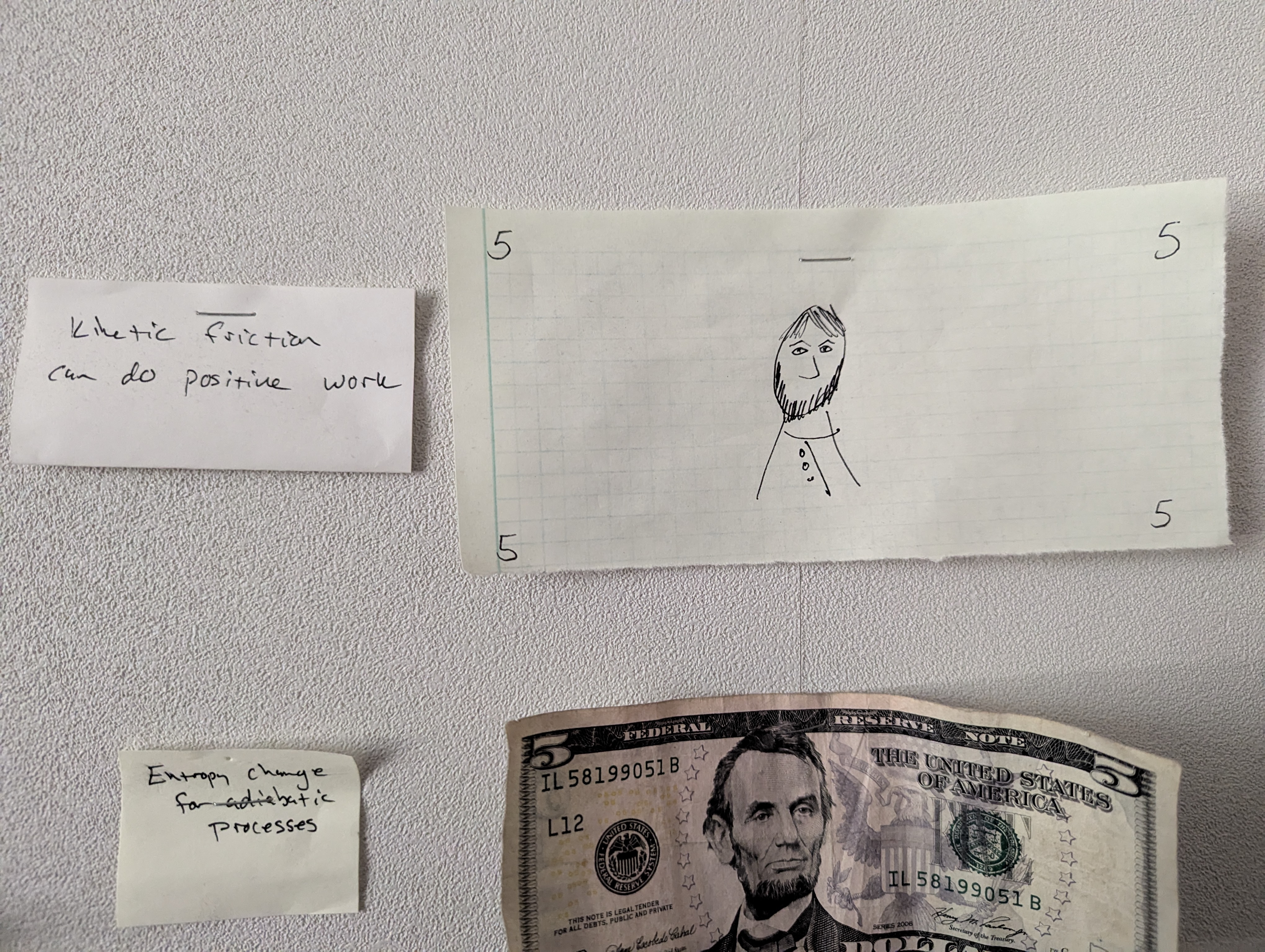
Can friction to positive work? What about kinetic friction?
Electric potential and Electric field
\[\Delta V = - \int_A^B \vec{E} \cdot d
\vec{l}\]
\[\vec{E} = -\vec{\nabla} V =
-\frac{\partial V}{\partial x} \hat{x} -\frac{\partial V}{\partial y}
\hat{y} -\frac{\partial V}{\partial z} \hat{z}\]
Line Integrals
A line
integral is an integral along a path between two points.
At each point along the path, we compute the dot product between the
electric field vector and the displacement vector, then add them all
up.
So, if we move:
- “with” the field, the electric potential will
decrease.
- “against” the field, the electric potential will
increase.
- perpendicular to the field, the electric potential will not
change.
Electric potential between points in a field
Electric potential created by point charges
Digression: The Hydrogen Atom
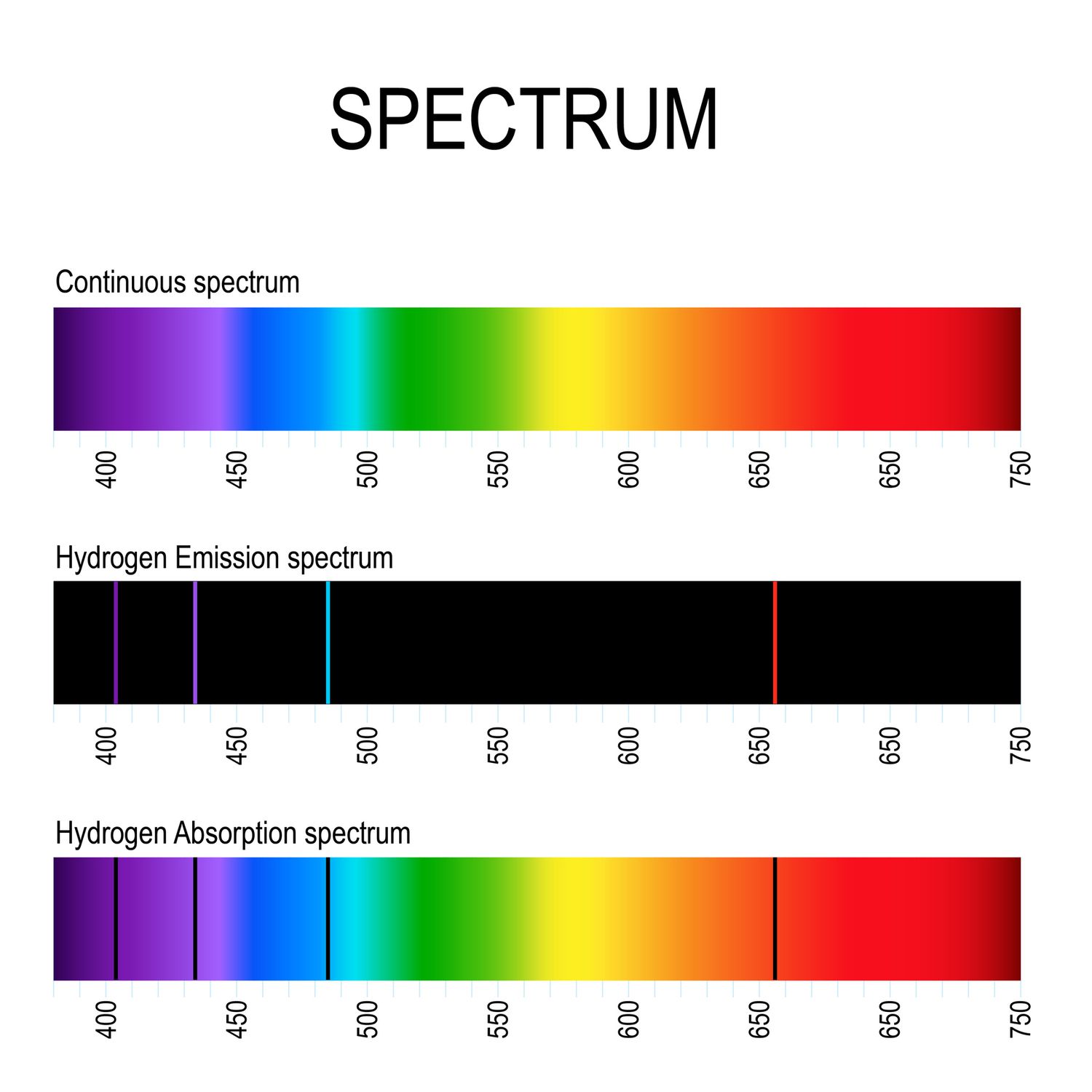
Digression: The Hydrogen Atom
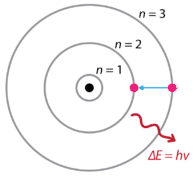
Bohr Model
Rydberg Formula
\[
\frac{1}{\lambda} = R_H \left( \frac{1}{n_1^2} - \frac{1}{n_2^2} \right)
\] where \(R_H = 1.097 \times 10^7
\text{m}^{-1}\)
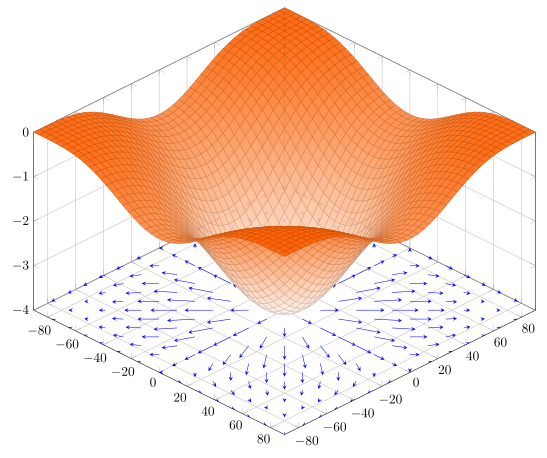
Electric Field and Electric Potential
\[\vec{E} = -\vec{\nabla} V =
-\frac{\partial V}{\partial x} \hat{x} -\frac{\partial V}{\partial y}
\hat{y} -\frac{\partial V}{\partial z} \hat{z}\]
Electric potential created by charge distributions
When we have a continuous distribution of charge, we have to break
the distribution up into small pieces, calculate the potential created
by each pieces, and add them together.
Converting Potential Energy to Kinetic Energy (and visa-versa)
The Large Hadron
Collider is a giant particle accelerator that we use to crash
protons into other protons.
Last Slide
Last Slide
Last Slide
Last Slide
Last Slide
Examples
Electric potential difference near a point charge.
- What is the electric potential produced by a point charge a distance
\(r\) from the charge?
Conducting Spheres and Electric Potential
A conducting sphere with radius \(R\) has an excess charge \(Q\) on it. What is the electric potential a
distance \(L\) from the sphere’s
surface?

What about the surface?
Potential energy of charge configurations
- If I have a charge, and I want to bring another charge close to it,
the two charges will exerted forces on each other.
- So it takes work to bring the charges together.
- If I then try to bring a third charge near the first two, it also
takes work.
- What is the total amount of work required to construct a charge
configuration?
Converting Potential Energy to Kinetic Energy
Potential energy has the potential to be converted to
kinetic energy. If we place two positive charges next to each other and
release them, they will accelerate away from each other.
A charge \(q_1\) with mass \(m_1\) is fixed at some position. A second
charge \(q_2\) with mass \(m_2\) is placed a distance \(d\) away from the first and released from
rest.
- What will the speed of \(q_2\) be
when it has traveled a distance \(x\)?
- What maximum speed will the charge \(q_2\) reach?
- What if \(q_1\) is not fixed?
Line Charges
A circular ring of charge lies in the \(x-y\) plane, centered at the origin. The
ring has a total charge \(Q\), and a
diameter \(D\). Determine the electric
potential produced by the ring at some position on the \(z\) axis (0,0,\(z\)).
Potential difference in a uniform electrric field
Potential energy of an electric dipole
Last Slide
Last Slide
Last Slide
Last Slide
Last Slide