Last Updated: Mon Oct 7 09:15:47 AM CDT 2024
Recall
\(R = \frac{\rho L}{A}\)
- Longer cylinders have a greater resistance.
- If we chain resistors together in series, the effective resistance
increases.
- Wider cylinders have lower resistance
- If we connect resistors together in parallel, the effective
resistance decreases.
Resistors in Series
Adding resistors in series increases the effective resistance
\(R_{eq} = R_1 + R_2 + \ldots\)
In series, the current through all resistors is the same.
Resistors in Parallel
Adding resistors in parallel reduces the effective resistance
\(\frac{1}{R_{eq}} = \frac{1}{R_1} +
\frac{1}{R_2} + \ldots\)
In parallel, the potential difference across all resistors is the
same.
Measuring Voltage and Current
A voltmeter measures voltage. You must connect it in
parallel with the thing you want to measure the voltage
across.
An ammeter measures current. You must connect it in series
with the thing you want to measure the current through.
A perfect volt meter would have an infinite
resistance.
A perfect ammeter would have zero
resistance.
Demo
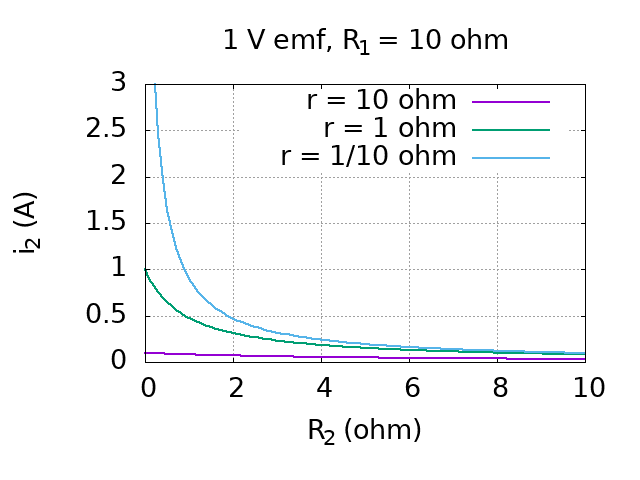
- Let’s connect some light bulbs in series and parallel…
Path of least resistance example
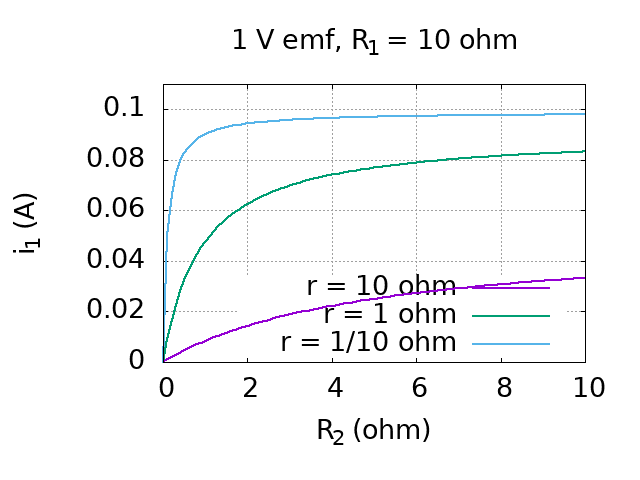
- This just refers to the fact that more current runs through smaller
resistors, but this only applies when there are more than one paths
available.
- The current through all resistors in series is the same, so this
applies to resistors in parallel.
- It does NOT mean that ALL current runs through the
path of least resistance… let’s have a look
Consider:
- three resistors connected to an emf in series
- three resistors connected to an emf in parallel
- two resistors in parallel connected to a third resistor in
series
Path of least resistance example
Resistors in “Other”
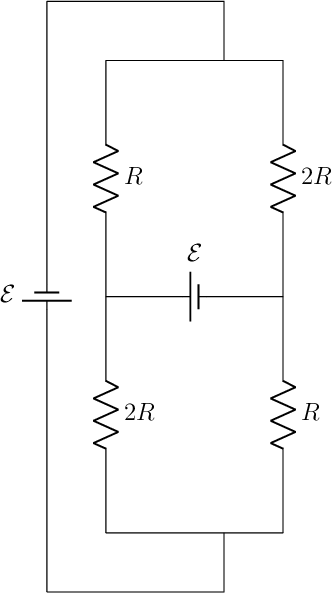
Sometimes a circuit contains resistors that are not connected in
series or parallel. In these cases, we must use Kirchhoff’s rules to
determine the current through each resistor.
Kirchhoff’s Rules
Loop Rule: The total potential difference around any closed loop in a
circuit must be zero.
Junction Rule: The current entering a junction must be equal to the
current leaving.
We have already discussed these, we are just going to learn how to
use them to analyze complex circuits.
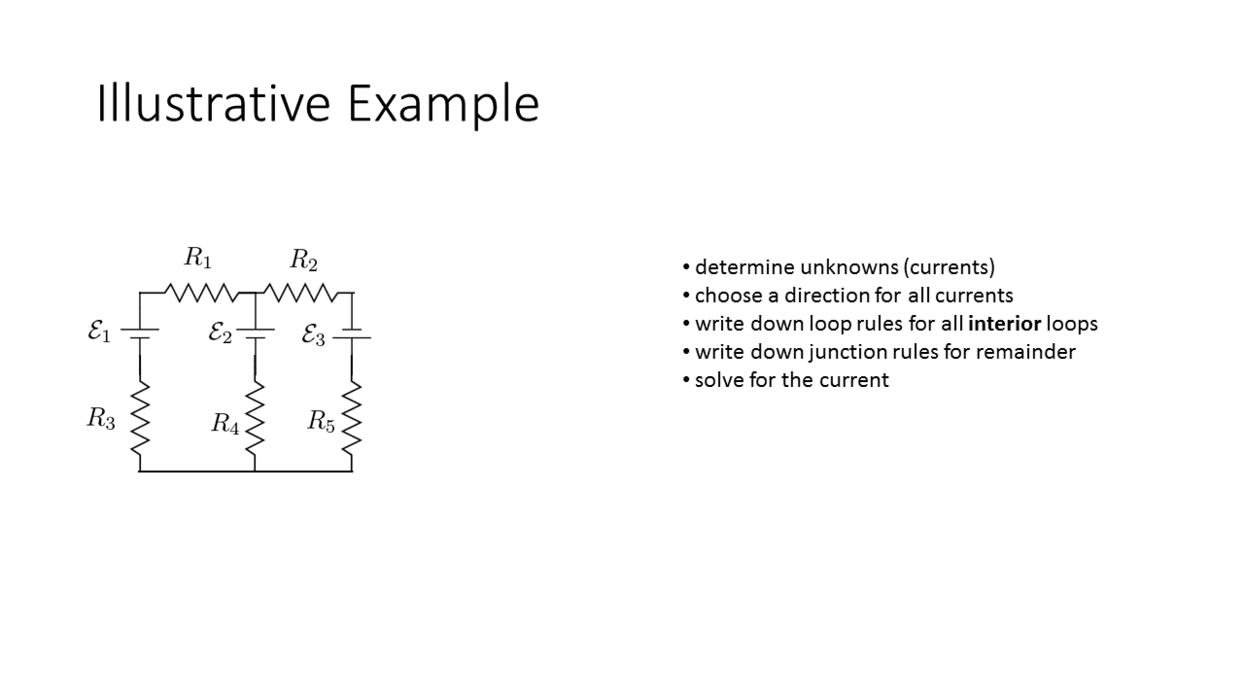
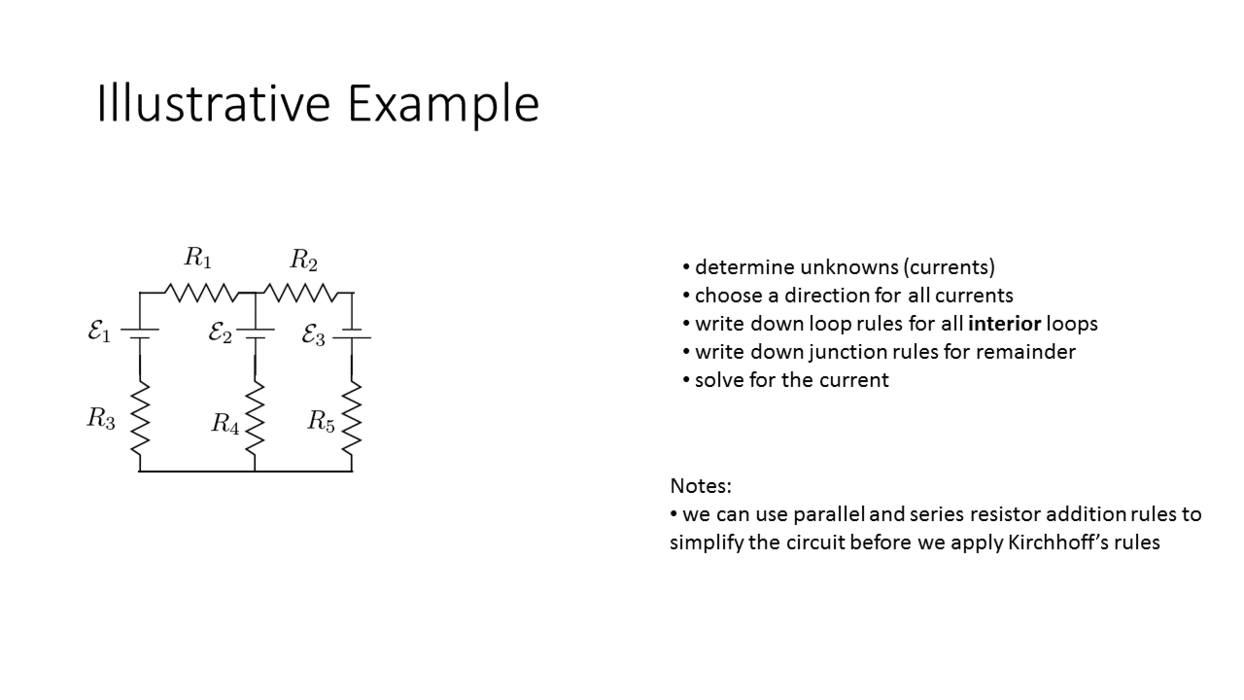
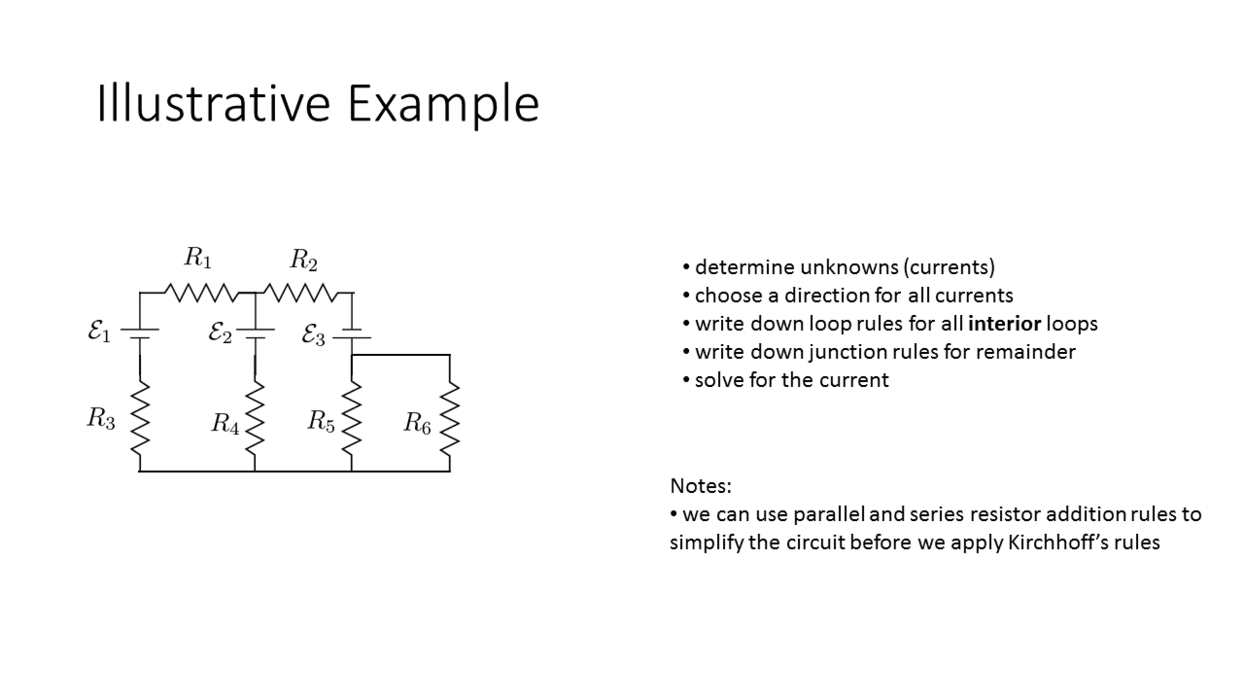
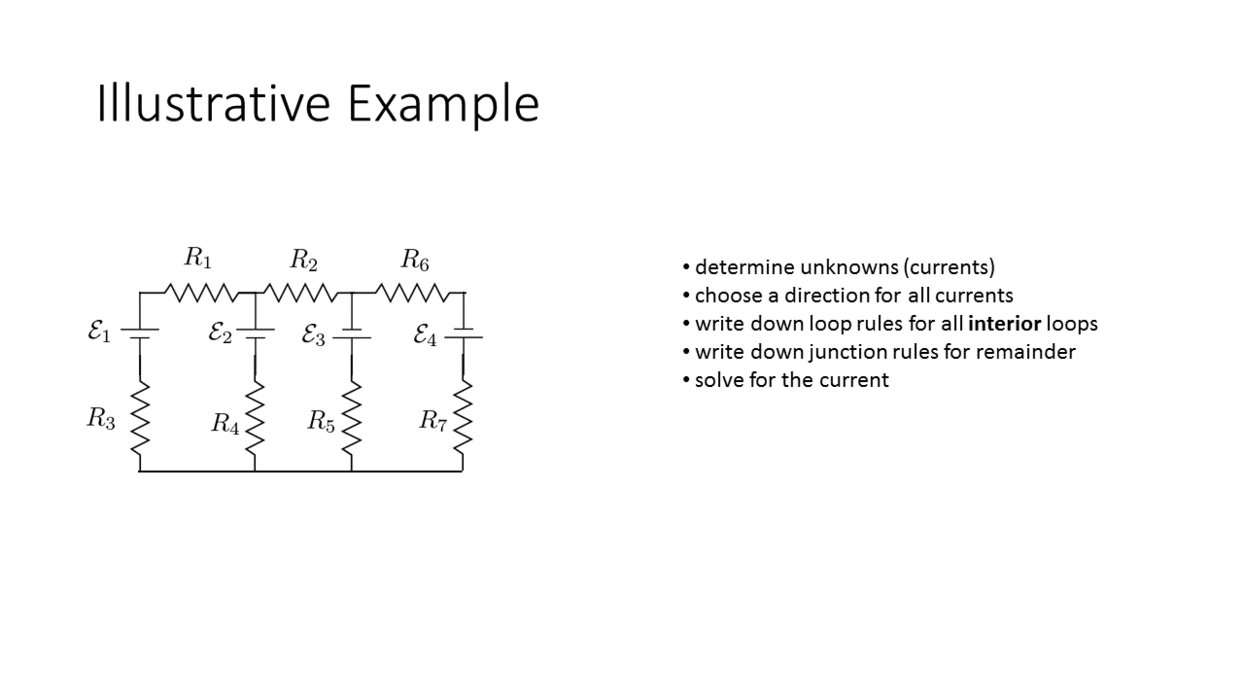
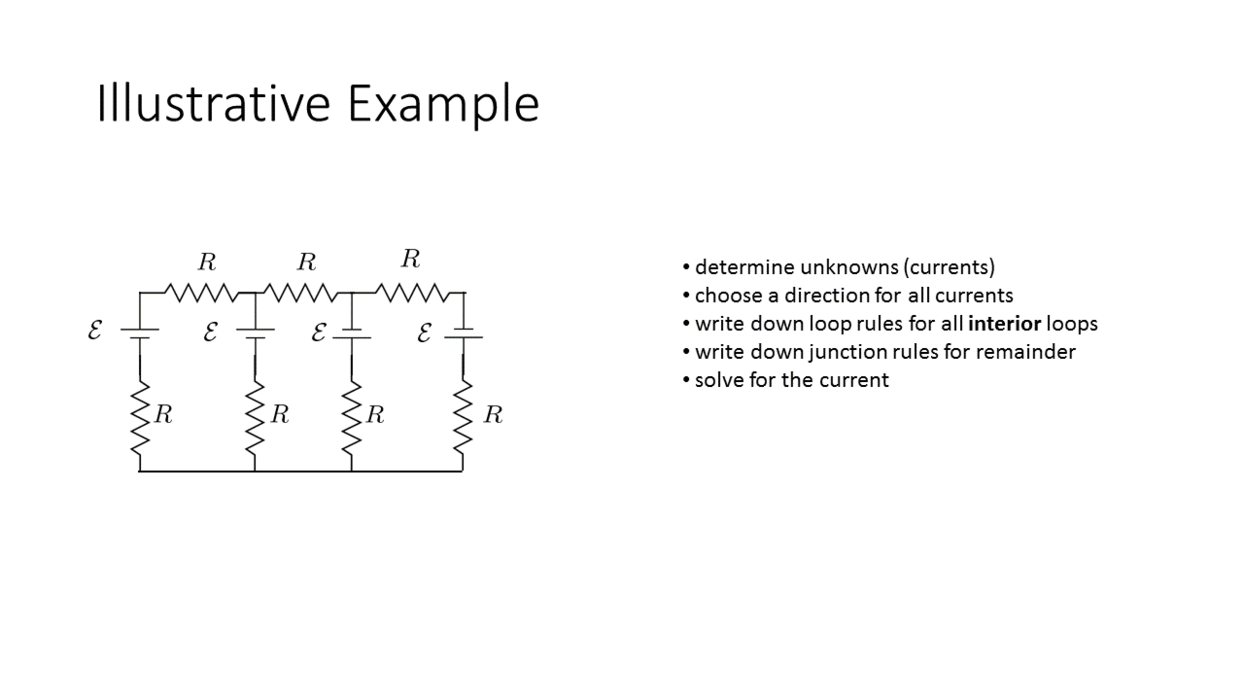
Kirchhoff’s Rules: Procedure
- Determine the number of unknown currents.
- Choose directions for all unknown currents.
- Write down loop rule for all interior loops.
- Write down junction rules until you have enough equations.
- Pro Tip (Jack): Use junctions with as few wires as possible.
_
_
_
_
_
Batteries in series and parallel
AAA, AA, C and D batteries are all 1.5 V, but we can make “new”
batteries by combining them.
For example, 9V
batteries

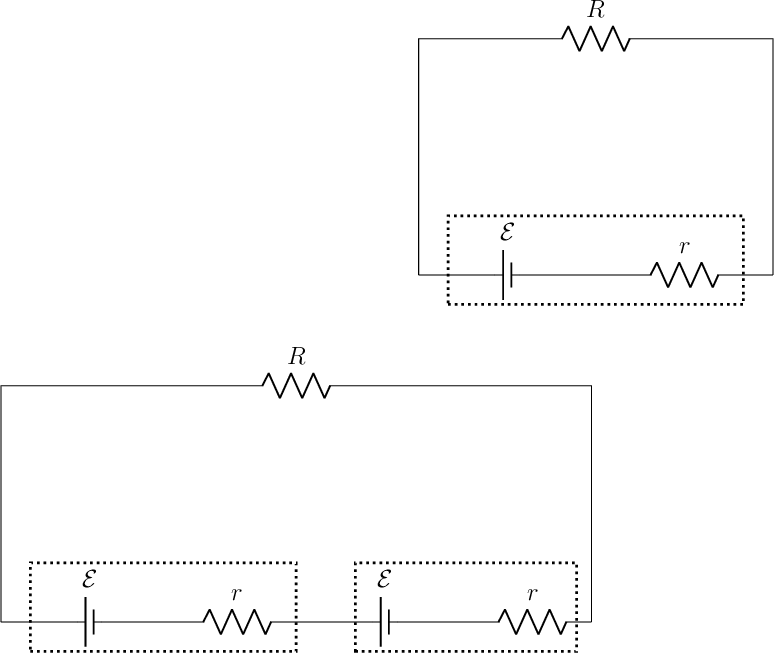
Example: Series Batteries
Determine the effective emf and internal resistance for two batteries
connected in series.
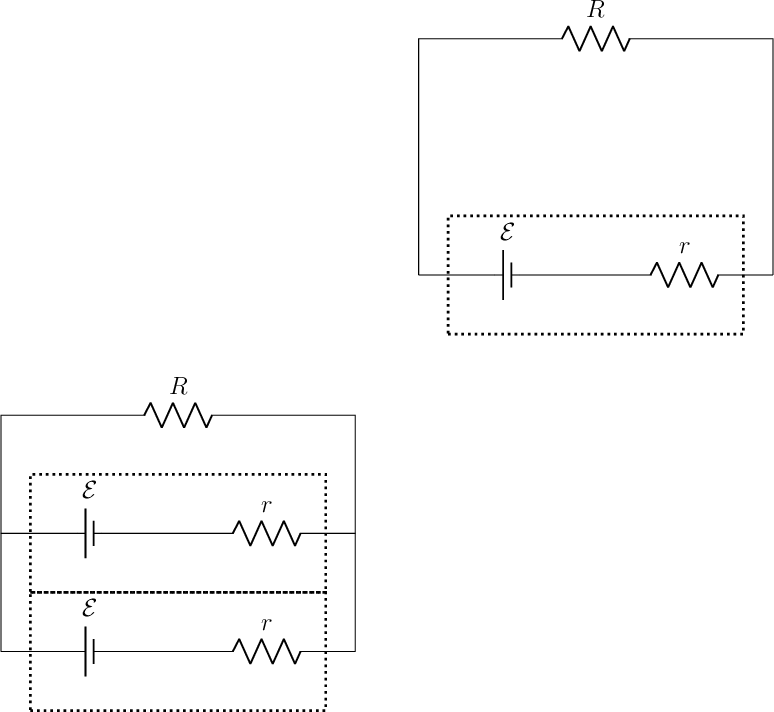
Example: Parallel Batteries
Determine the effective emf and internal resistance for two batteries
connected in parallel.
Example: Parallel/Series Batteries
What about combinations of parallel and series?
How many 9V batteries would we need to start a car?
Need at least 200 Amp of current. The internal resistance of a 9V
battery is about 1-2 ohm, but a car battery has an internal resistance
of about 0.02 ohm.
Last Slide
Last Slide
Last Slide
Last Slide
Last Slide
Last Slide
Last Slide
Last Slide
Examples
A 9-V battery is connected in parallel with a 6 V battery. These are
then connected in series with two 1.5-V batteries. The 9-V
battery has an internal resistance \(r\), the 6-V battery has an internal
resistance \(2r\), and the 1.5-V
batteries each have an internal resistance \(3r\). Assume that \(r = 1 \Omega\), and the batteries are
connected to a 100-Ohm load resistor.
- Draw a circuit diagram for this setup.
- What is the voltage across the load resistor?
- What is the voltage across the 6-V battery?
- What is the current through the 1.5-V batteries?