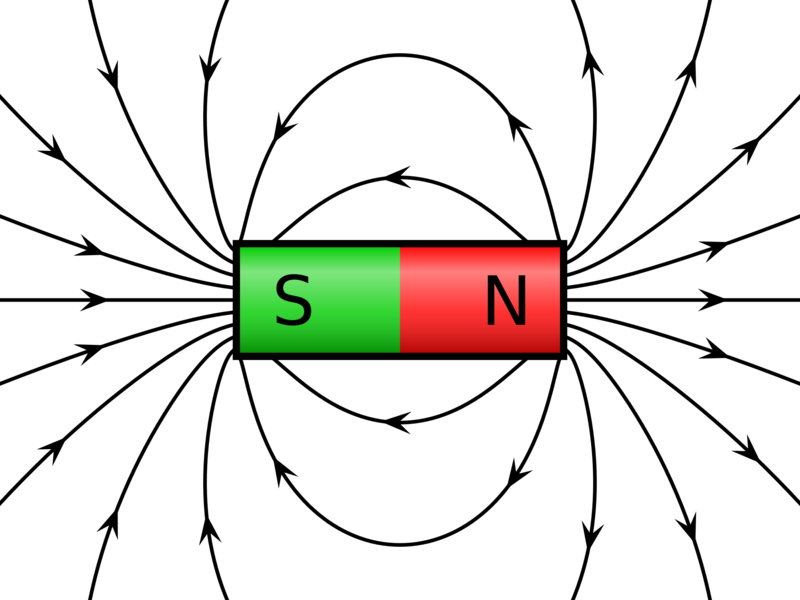
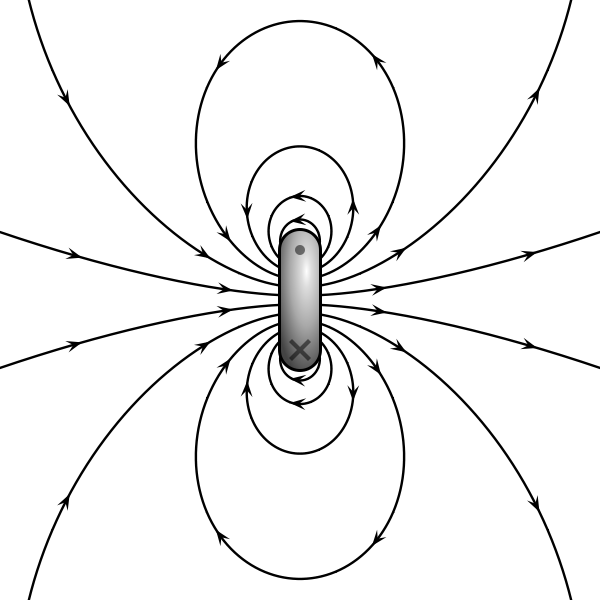
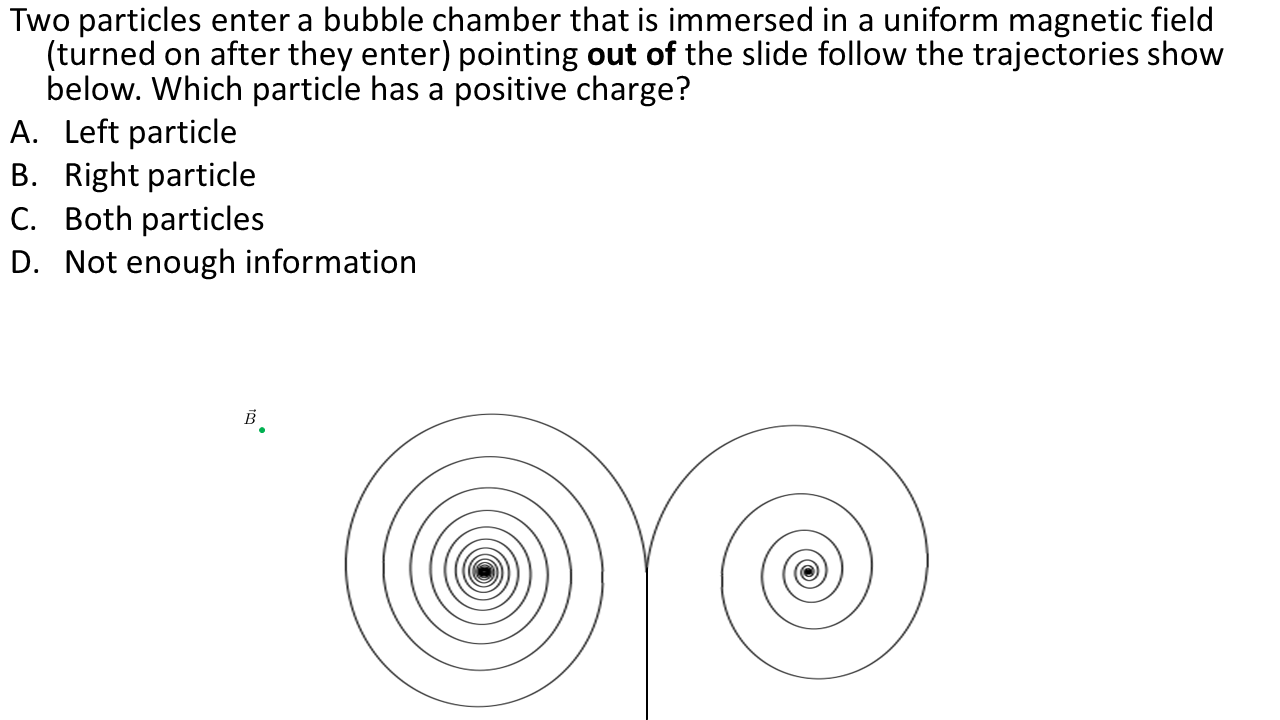
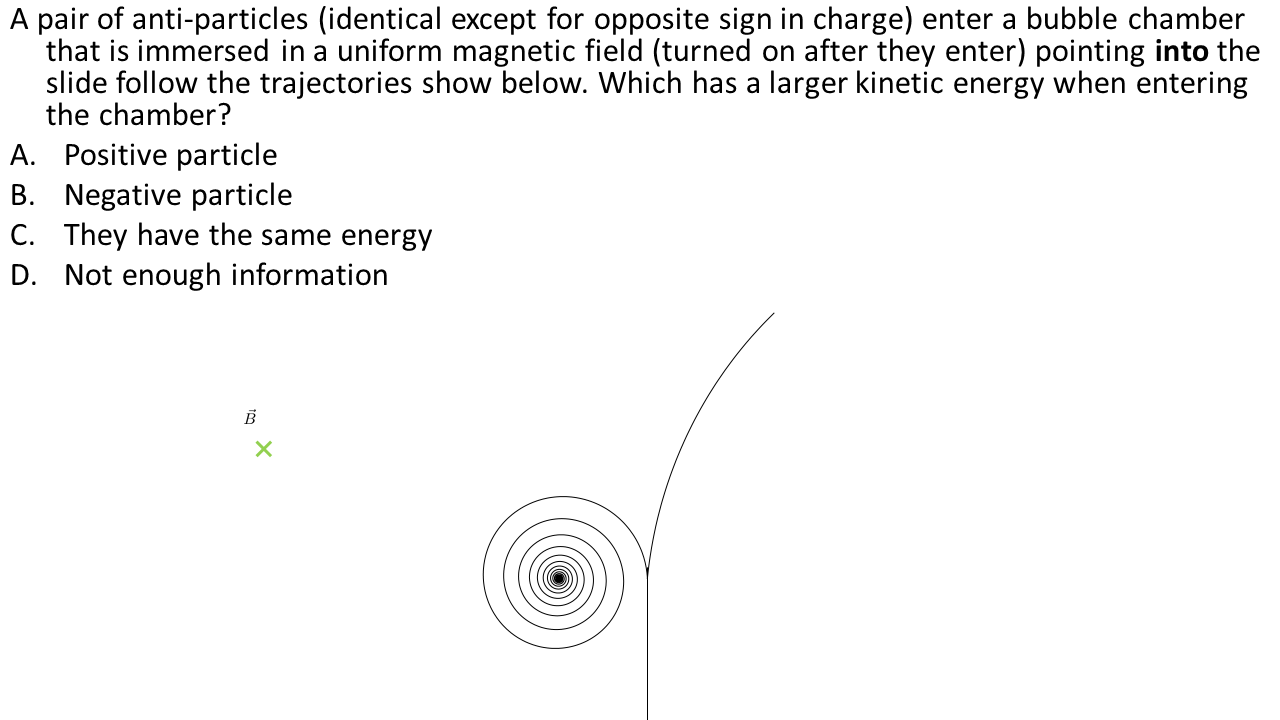
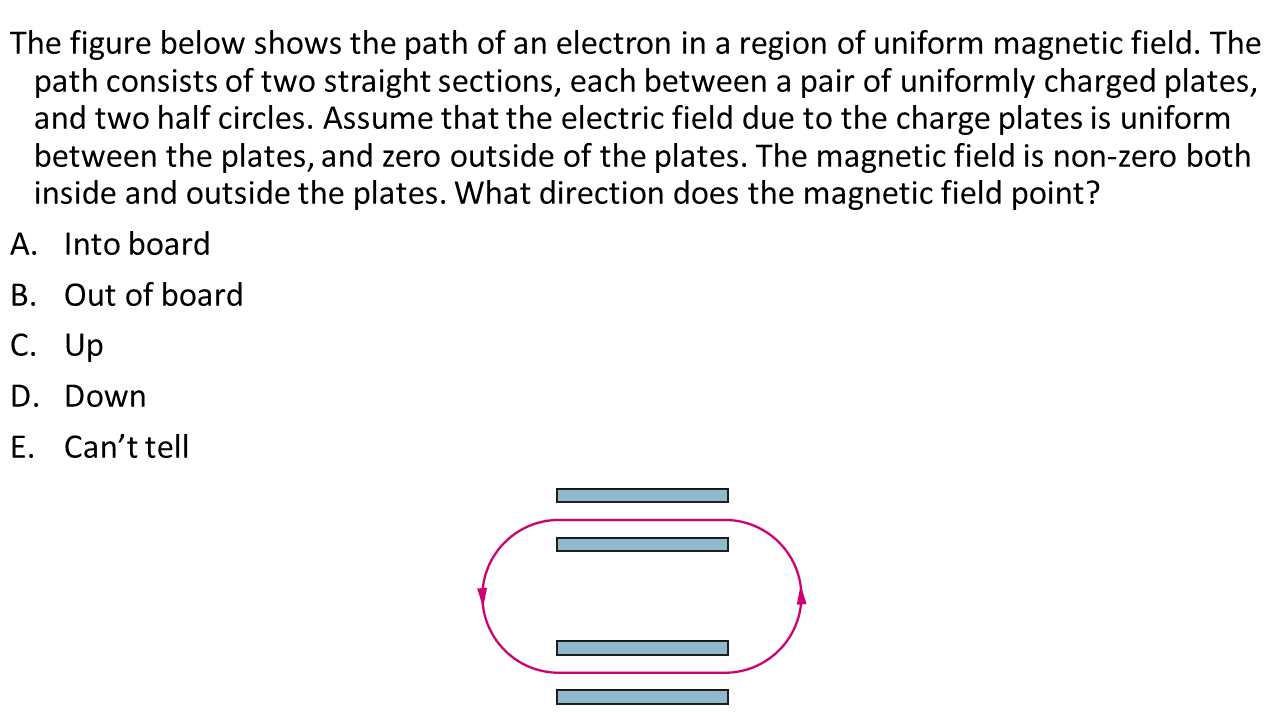
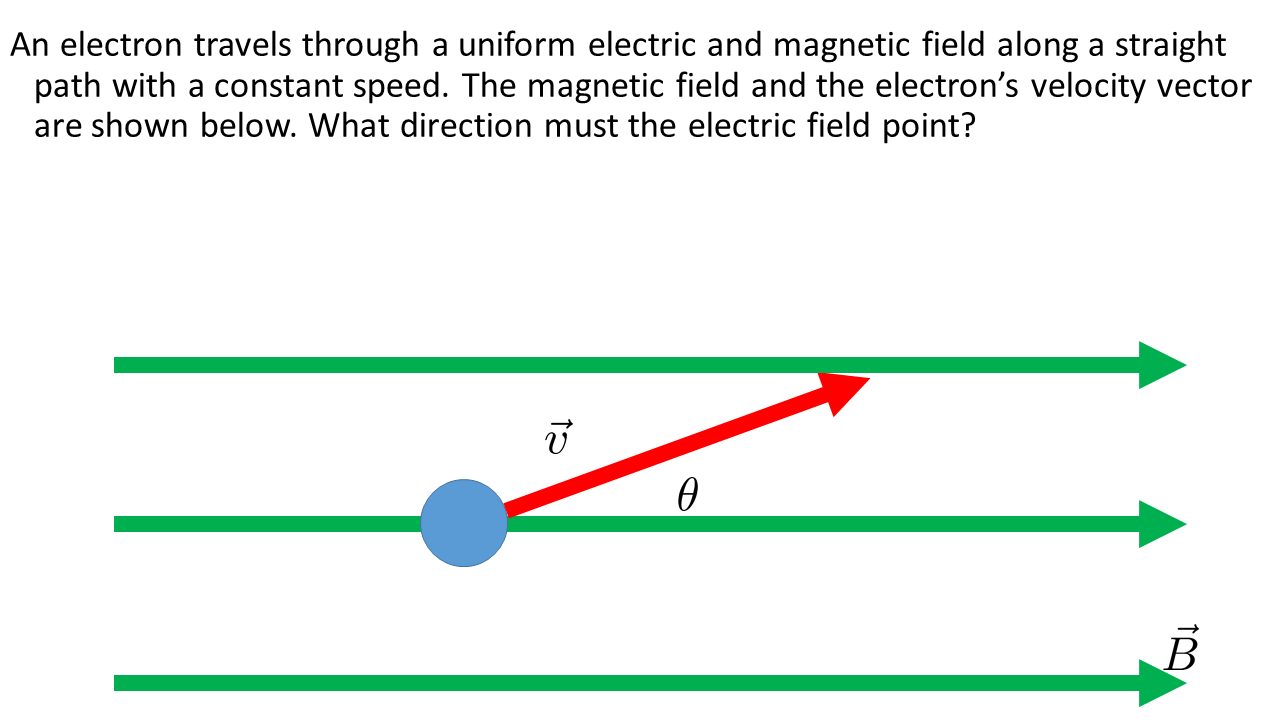
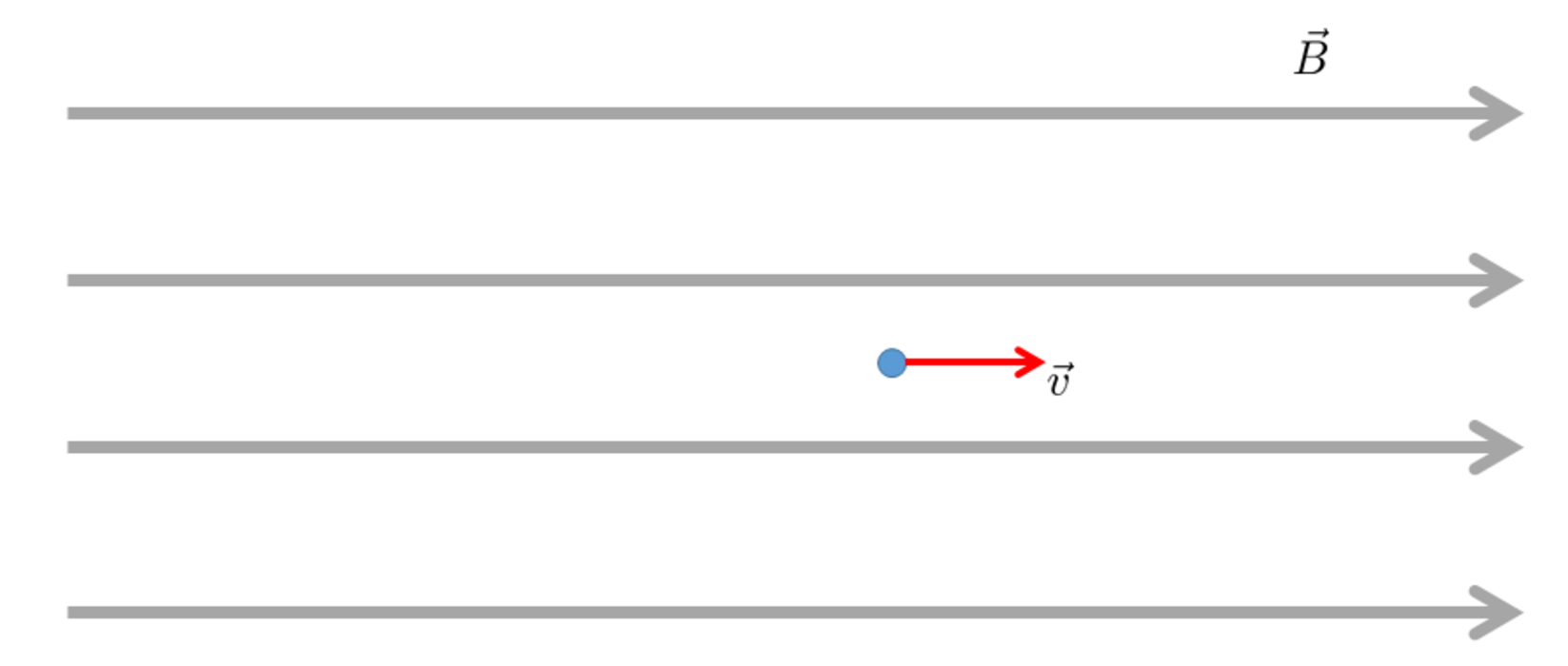
zero if the particle travels in the direction of the field.
perpendicular to both the velocity of the particle and the
field.
_
Right-Hand Rule
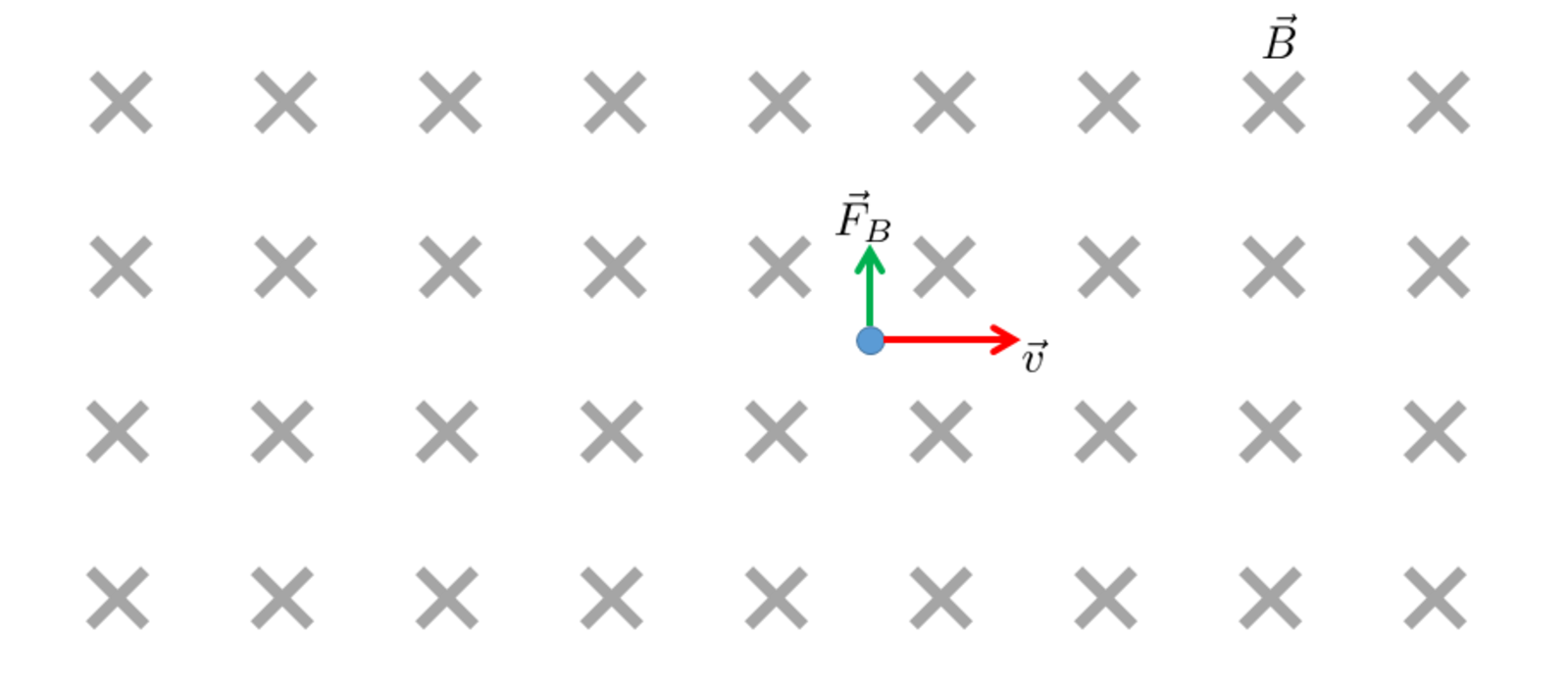
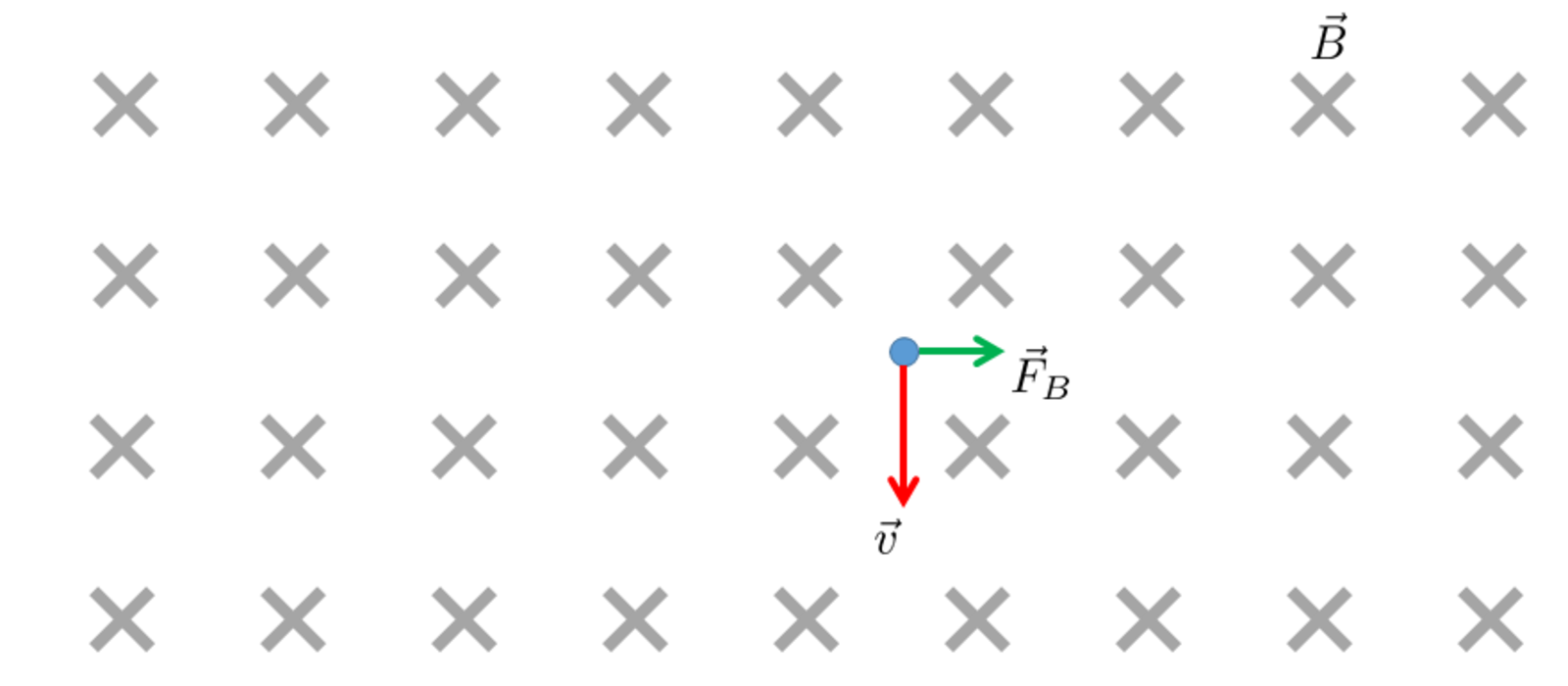
The cross product between two vectors produces a third vector.
The right-hand rule can be used to determine the direction of this
third vector.
For the cross product \(\vec{c} = \vec{a}
\times \vec{b}\), the direction of \(\vec{c}\) is given by:
Point your fingers in the direction of the first vector (\(\vec{a}\))
Curl your fingers into the direction of the second (\(\vec{b}\))
Your thumb points in the direction of the third (\(\vec{c}\))
Right-Hand Rule
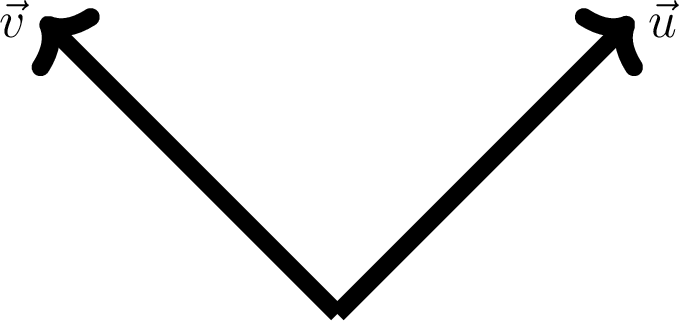
What direction does \(\vec{u} \times
\vec{v}\) point?
What direction does \(\vec{v} \times
\vec{u}\) point?
Right-Hand Rule
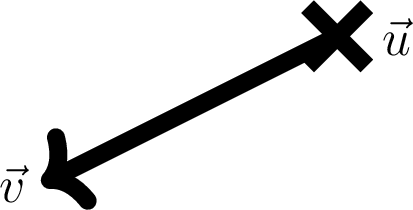
What direction does \(\vec{u} \times
\vec{v}\) point?
What direction does \(\vec{v} \times
\vec{u}\) point?
Right-Hand Rule
positive charge travels in the \(+y\) direction, magnetic field points in
the \(+z\) direction. What direction is
the force?
positive charge travels in the \(-x\) direction, magnetic field points in
the \(+z\) direction. What direction is
the force?
positive charge travels in the \(+y\) direction, magnetic field points in
the \(-x\) direction. What direction is
the force?
positive charge travels in the \(+y\) direction, magnetic field points in
the \(-x\) direction. What direction is
the force?
negative charge travels in the \(+y\) direction, magnetic field points in
the \(+z\) direction. What direction is
the force?
negative charge travels in the \(-x\) direction, magnetic field points in
the \(+z\) direction. What direction is
the force?
negative charge travels in the \(+y\) direction, magnetic field points in
the \(-x\) direction. What direction is
the force?
negative charge travels in the \(+y\) direction, magnetic field points in
the \(-x\) direction. What direction is
the force?
Right-Hand Rule
positive charge travels in the \(+y\) direction, force in the \(+z\) direction. What direction is the
field?
positive charge travels in the \(-z\) direction, force in the \(-y\) direction. What direction is the
field?
negative charge travels in the \(-x\) direction, force in the \(+z\) direction. What direction is the
field?
negative charge travels in the \(-z\) direction, force in the \(+x\) direction. What direction is the
field?
Right-Hand Rule
unknown charge travels in the \(+y\) direction, field points in the \(+x\) direction and exerts force in the
\(+z\) direction. What is the sign of
the charge?
unknown charge travels in the \(+z\) direction, field points in the \(+x\) direction and exerts force in the
\(-y\) direction. What is the sign of
the charge?
unknown charge travels in the \(-x\) direction, field points in the \(+y\) direction and exerts force in the
\(+z\) direction. What is the sign of
the charge?
unknown charge travels in the \(-z\) direction, field points in the \(+y\) direction and exerts force in the
\(+x\) direction. What is the sign of
the charge?
The motion of charge in a magnetic field: Circular Motion
In order to travel around a circle, a particle must have a radial
acceleration equal to \[
a_r = \frac{v^2}{R}
\] If this radial acceleration is provided by a magnetic field,
then \[
a_r = \frac{F_B}{m} = \frac{qvB\sin\theta}{m}
\]
When \(\theta = 90^\circ\), we get
uniform circular motion.
Helical Motion
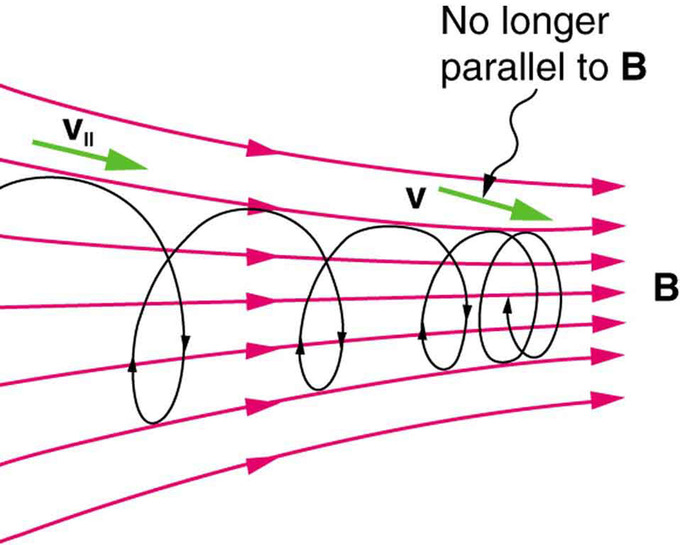
If \(\theta \ne 90^\circ\), we get
helical motion.
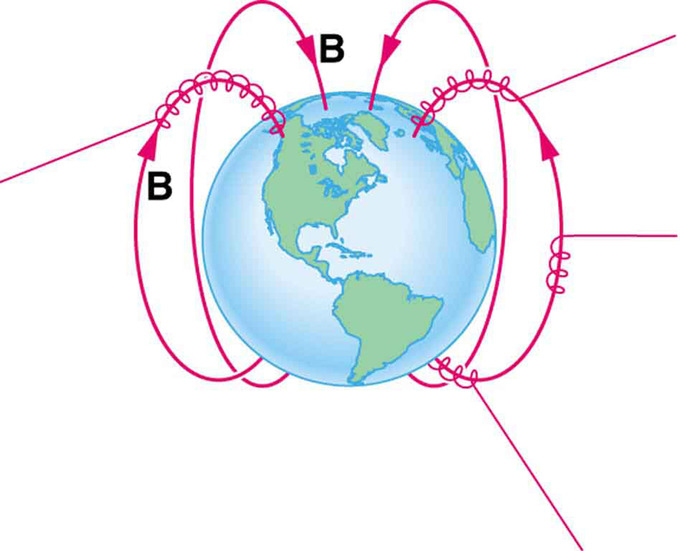
The Magnetosphere
The Magnetosphere
The Magnetosphere: Northern Lights
The Magnetosphere: Southern Lights
Northern Lights
Southern Lights
Particle Accelerator
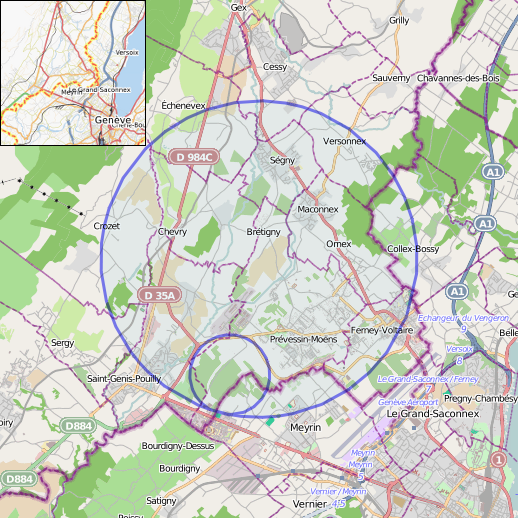
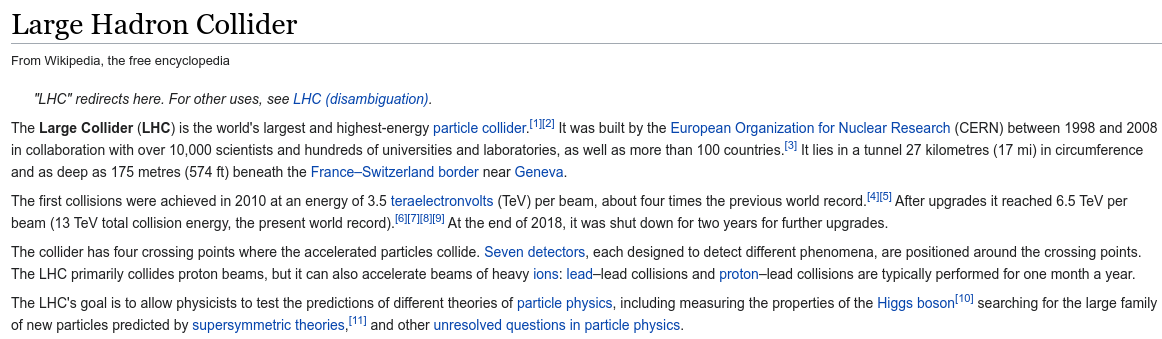
The CERN particle accelerator (LHC) is a 27 km circumference ring
used to accelerated charged particles, such as protons, to great speeds.
It uses large magnets to direct the charges particles around the
loop.
Force on Wires
Magnetic fields also exert a force on wires that carry current:
\(\vec{F} = i \vec{L} \times
\vec{B}\)
\(F = i L B \sin\theta\)
Force on Wire Model
We can think of a current carrying wire as a pipe with particles
traveling through it…
Torque on Magnetic Moment and Potential Energy
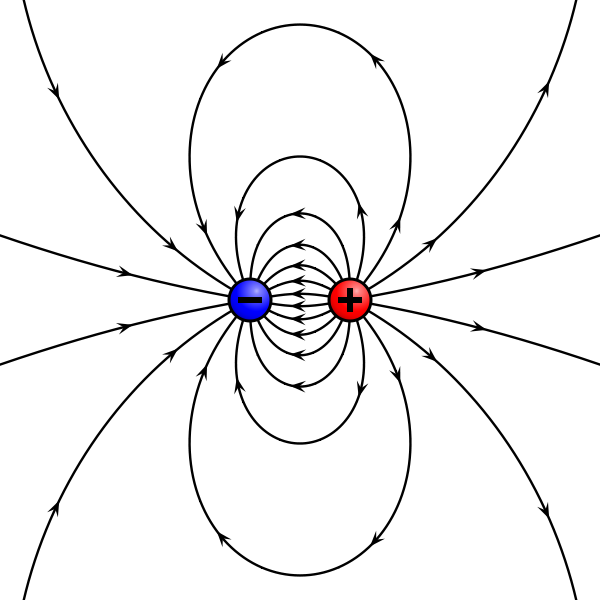
Electric Field
Electric dipoles have an “electric dipole moment”, \(\vec{p} = q\vec{d}\).
Recall that the electric field exerts a torque on an
electric dipole, \(\vec{\tau} =
\vec{p}\times\vec{E}\).
Electric dipoles store potential energy, \(U = -\vec{p} \cdot \vec{E}\).
Magnetic Field
Magnetic diples have a “magnetic diple moment”, \(\vec{\mu}\).
Bar magnets have a magnetic dipole moment.
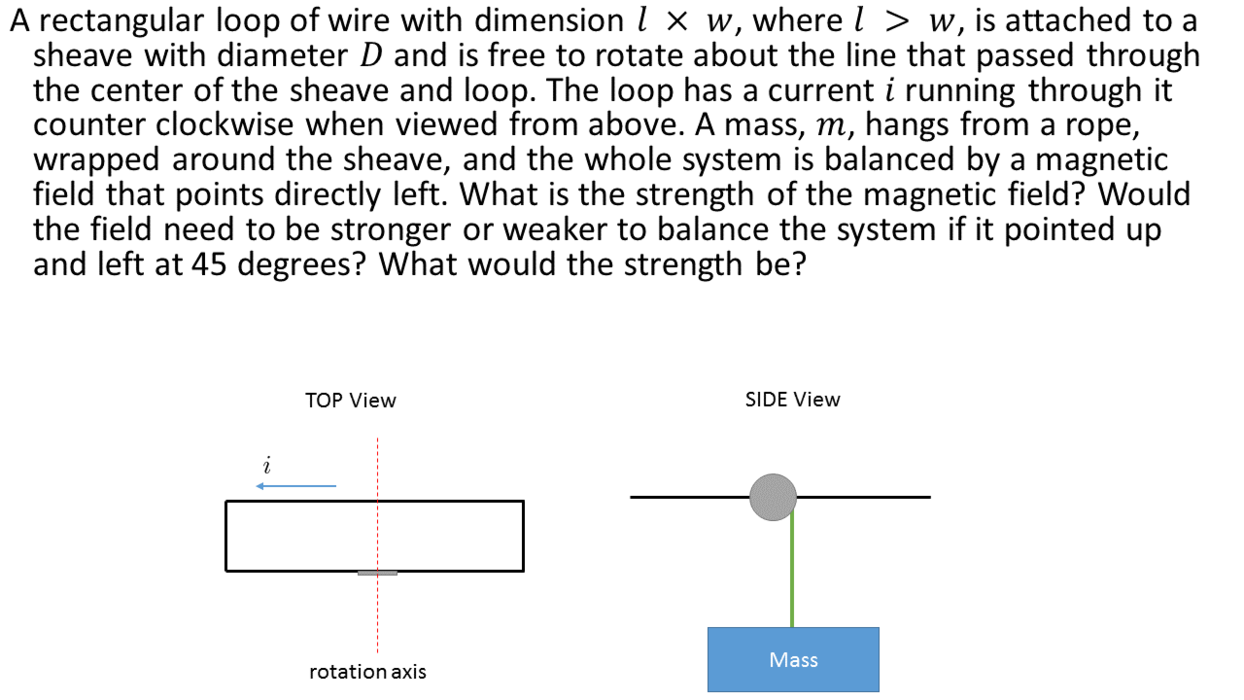
If we run current through a loop of wire, it will have a magnetic
dipole moment: \(\vec{\mu} = i A
\hat{n}\).
Magnetic fields exert a torque on magnetic
dipoles, \(\vec{\tau} =
\vec{\mu}\times\vec{B}\).
Magnetic dipoles store potential energy, \(U = -\vec{\mu} \cdot \vec{E}\).
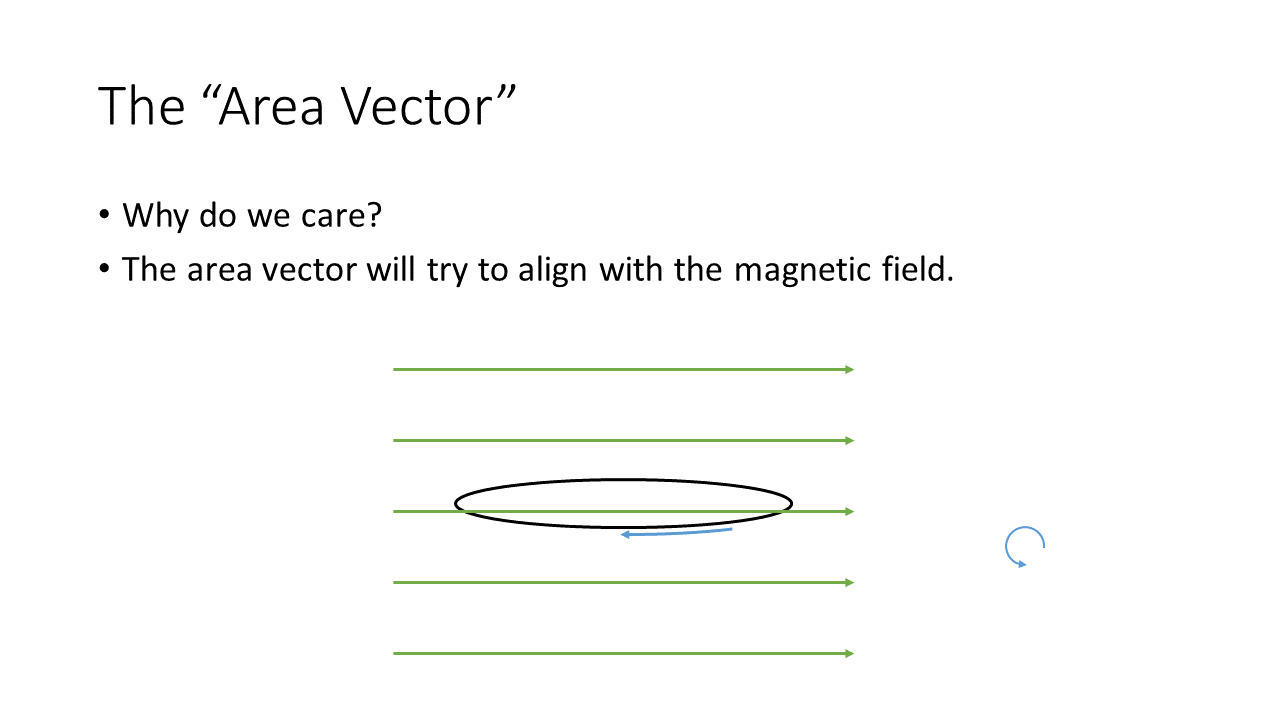
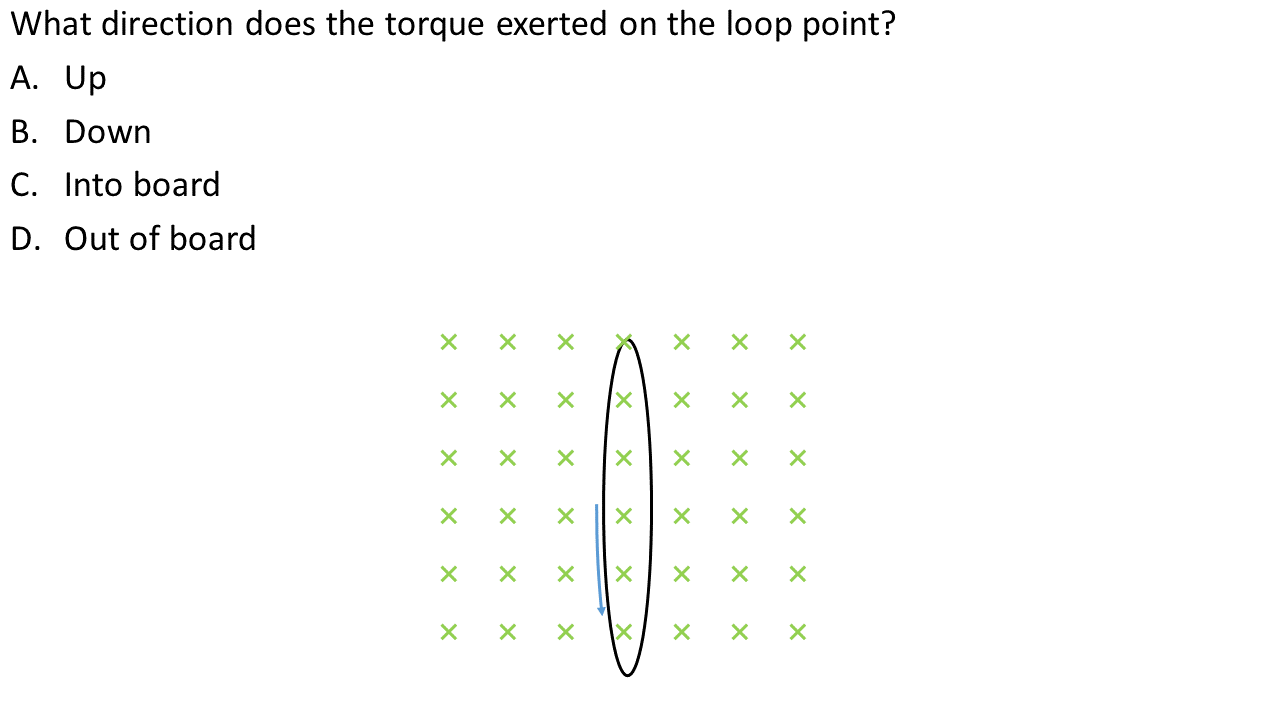
Torque and the “Area Vector”
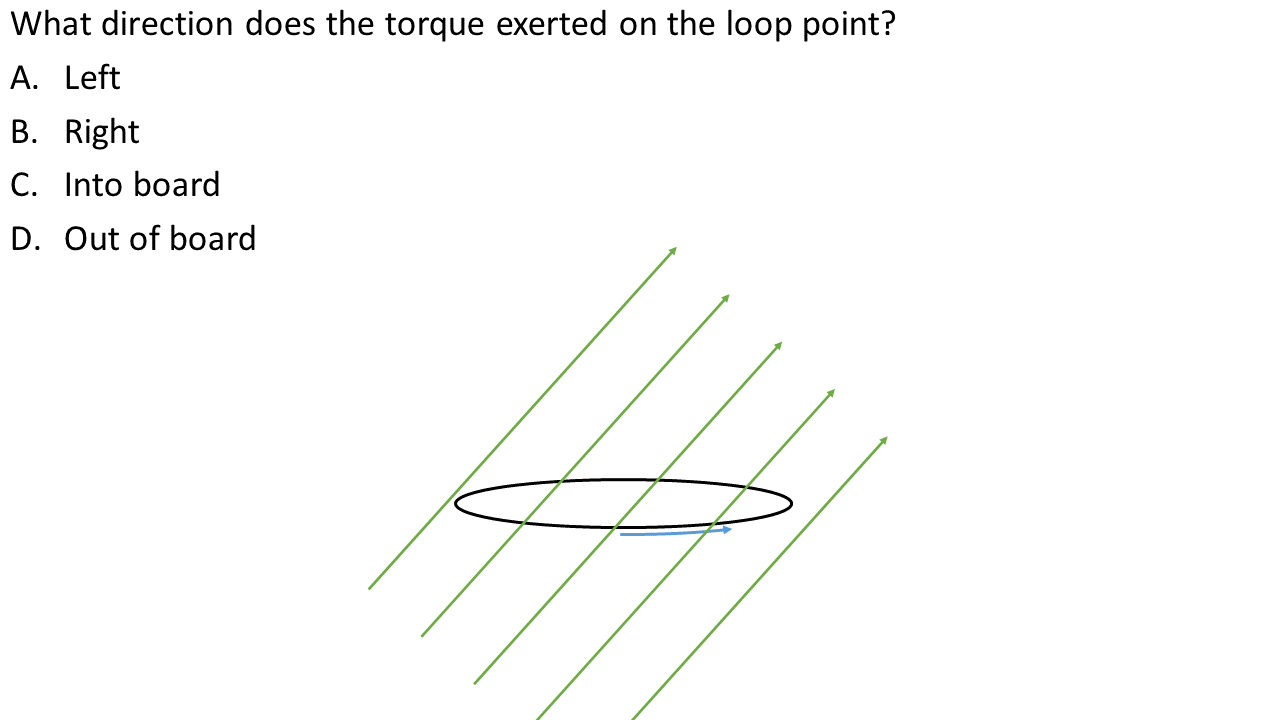
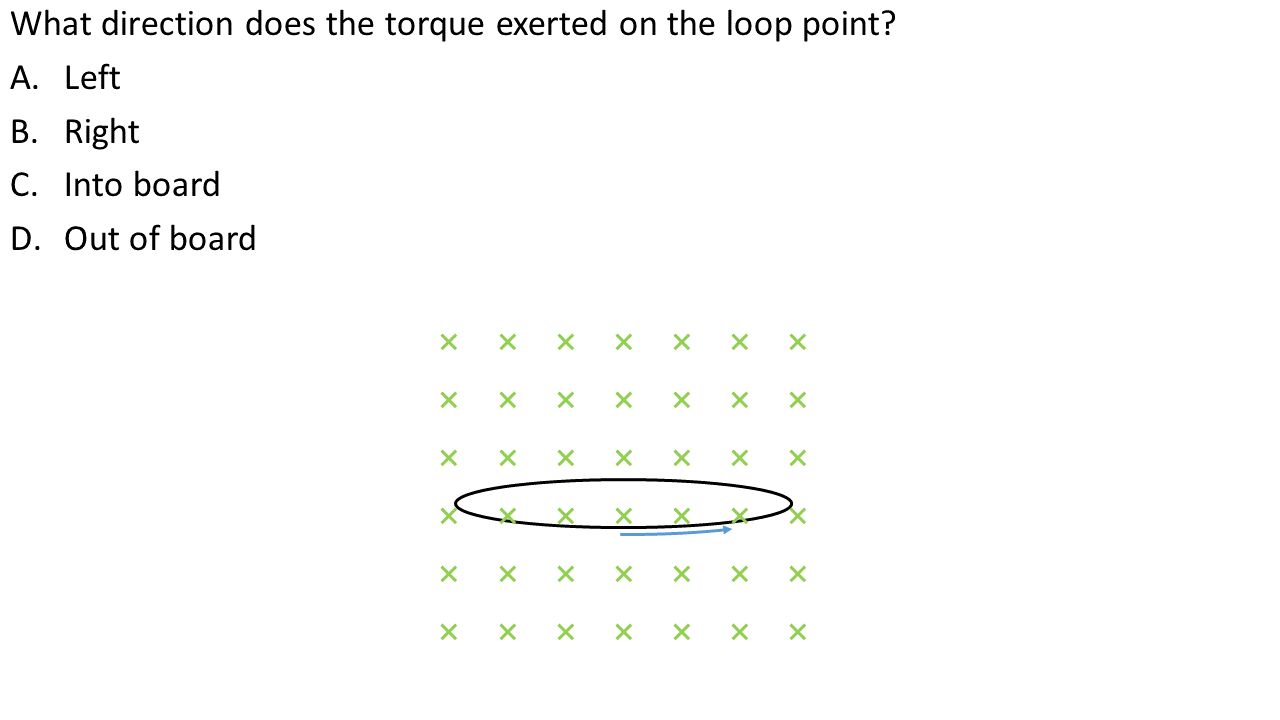
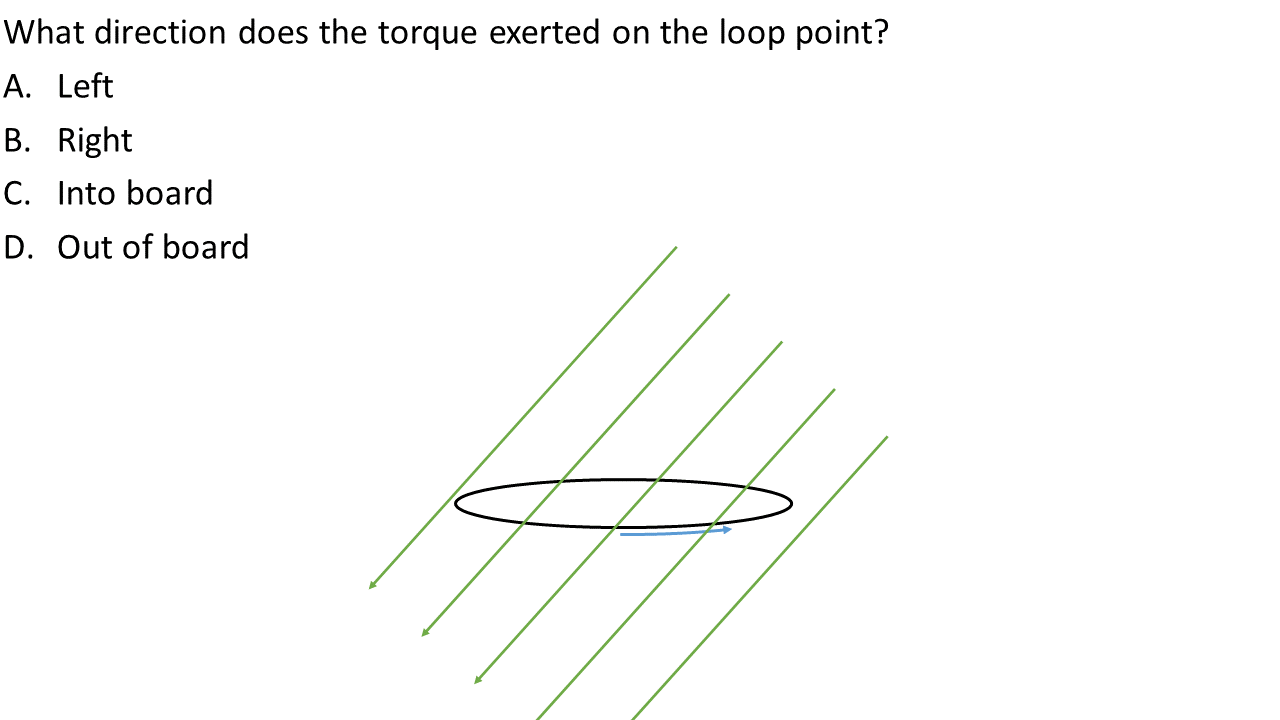
The torque exerted on a closed loop by a magnetic field is: \(\tau = \vec{\mu}\times\vec{B}\)
For a current loop, \(\vec{\mu} =
iA\hat{n}\)
We can define the “area vector” to be a vector that:
points perpendicular to the loop.
has a magnitude equal to the area of the loop.
i.e. \(\vec{A} = A\hat{n}\)
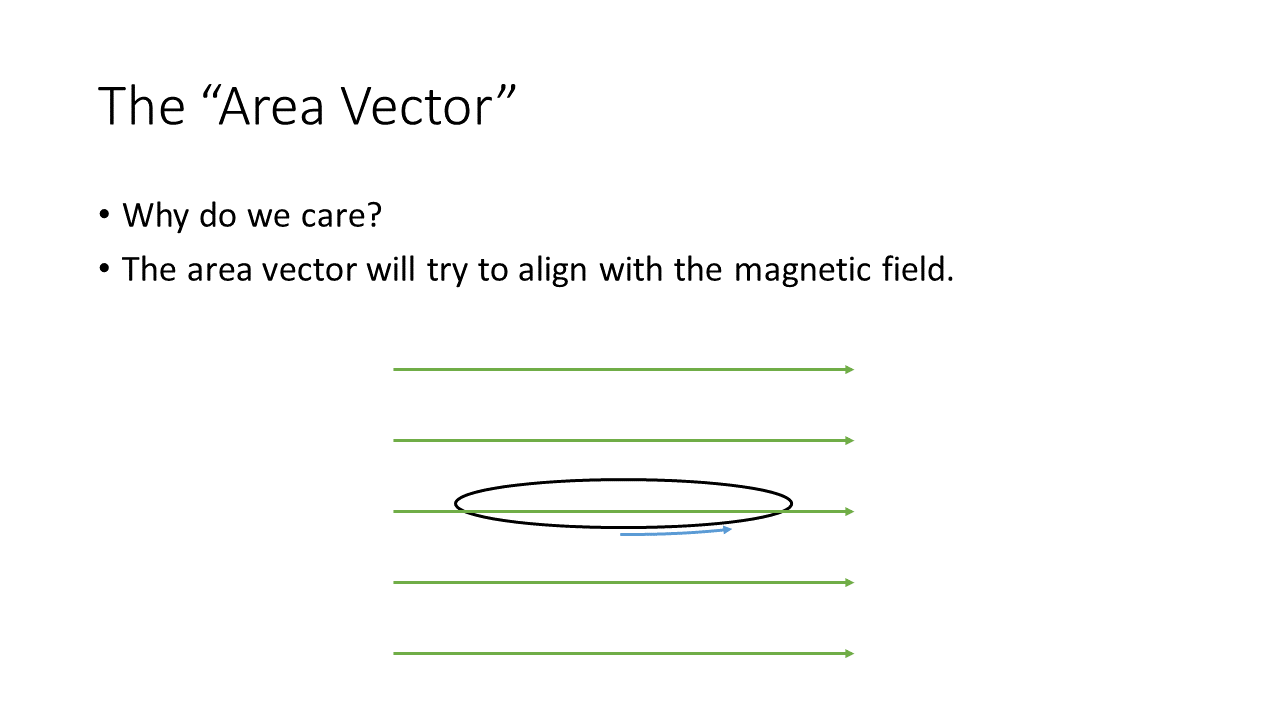
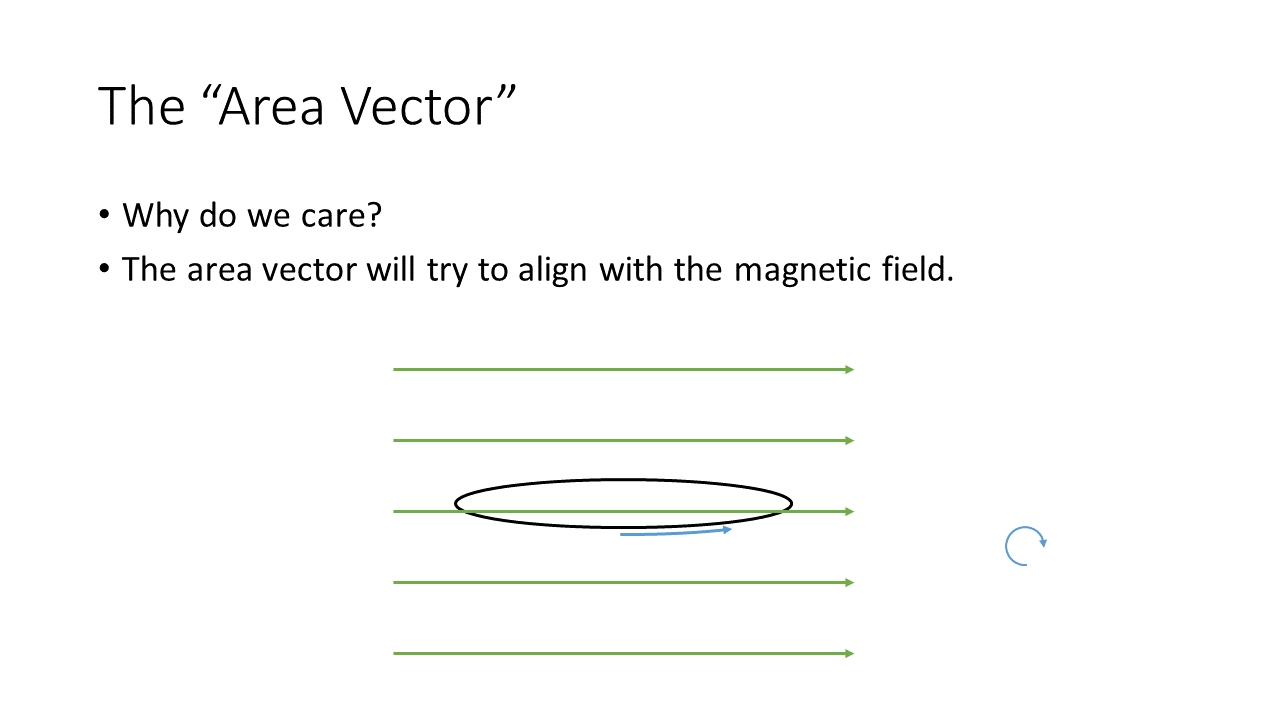
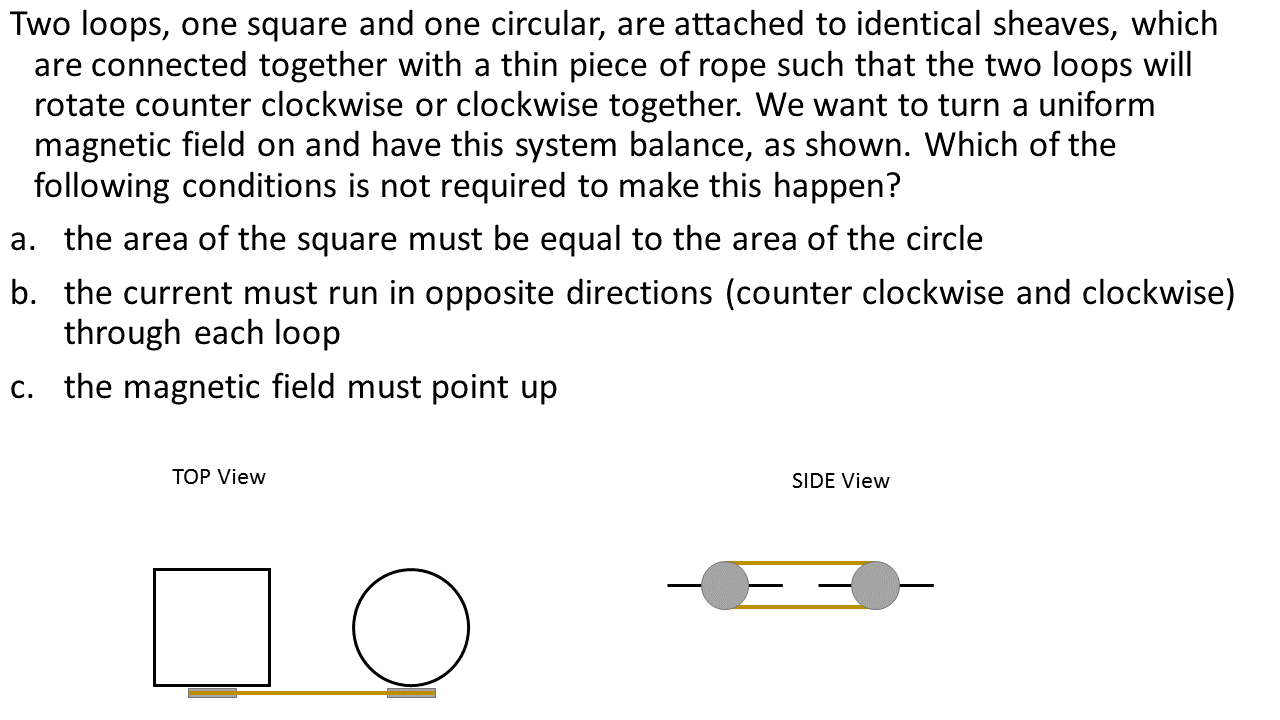
Why do we care? A magnetic force will exert a torque on a current
loop that will cause the area vector to align with the
field.
Electric motors
This is the principle that electric motors are based on.
_
_
_
_
_
_
_
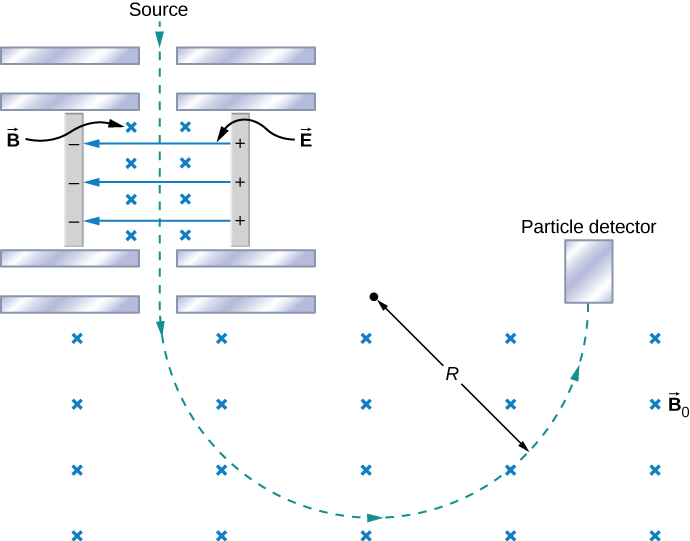
Crossed Fields
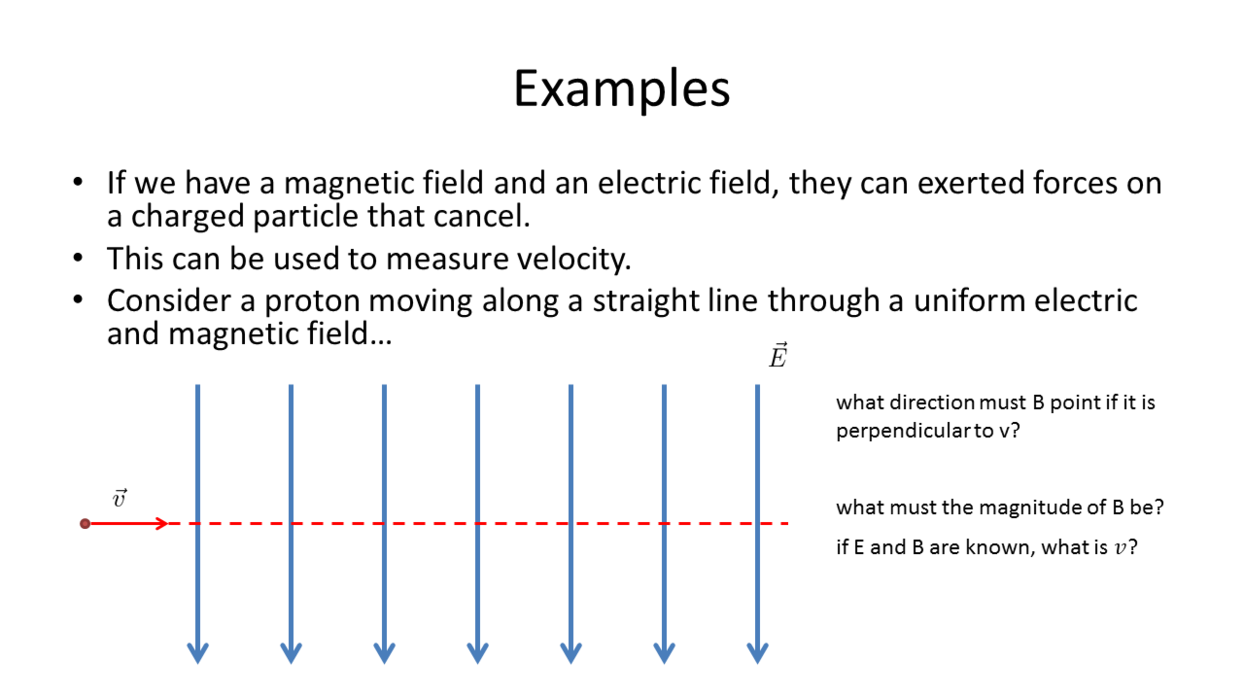
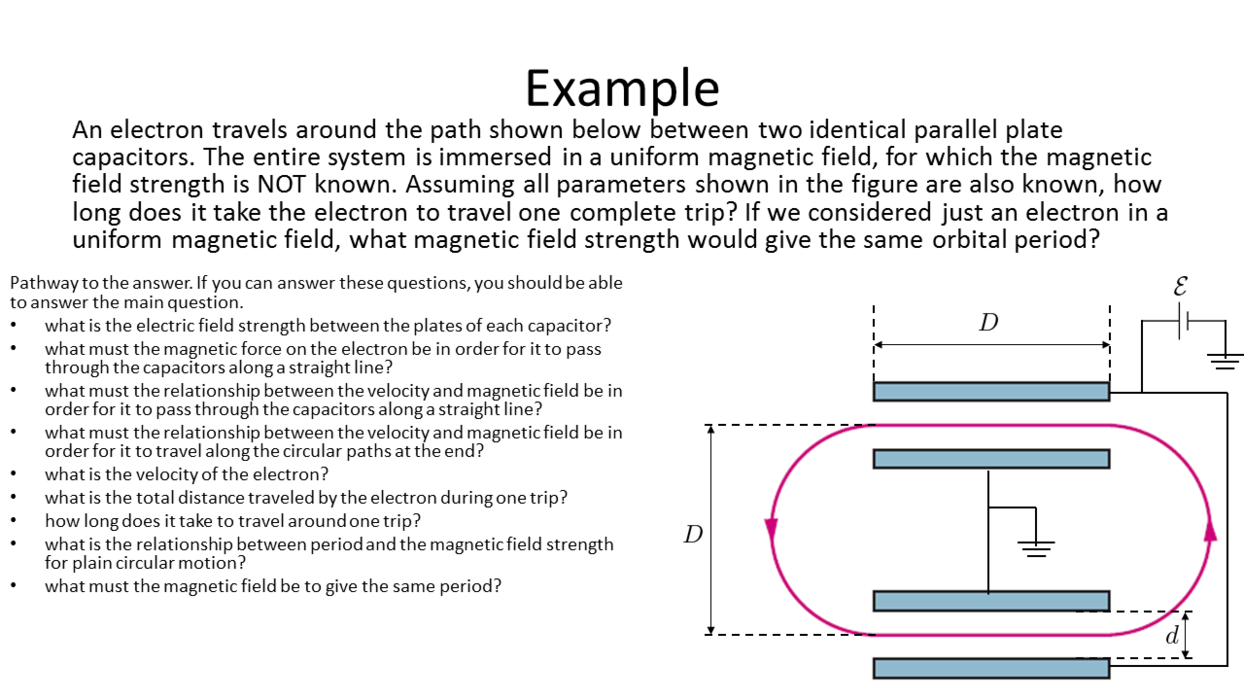
If charge moves through a region with both electric
and magnetic fields, both fields will exert a force on the
charge.
But one (the magnetic force) will depend on the particle’s speed.
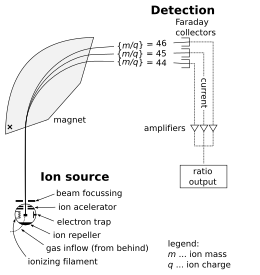
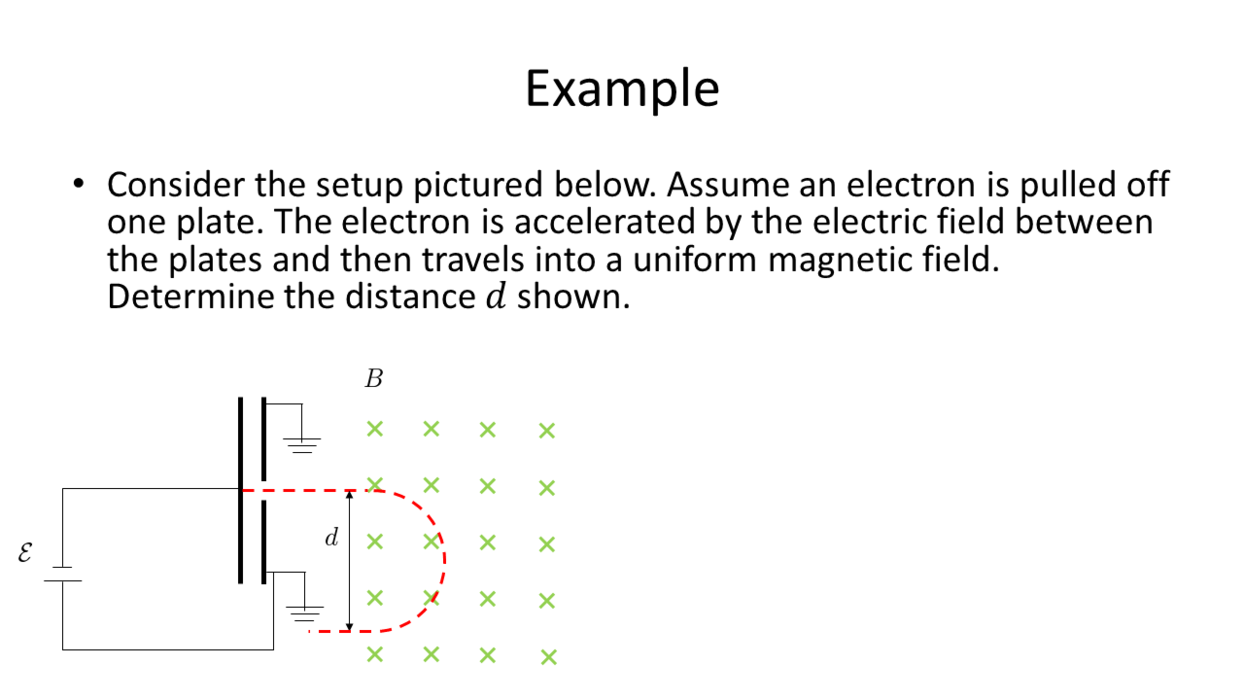
Application: Mass Spectrometer
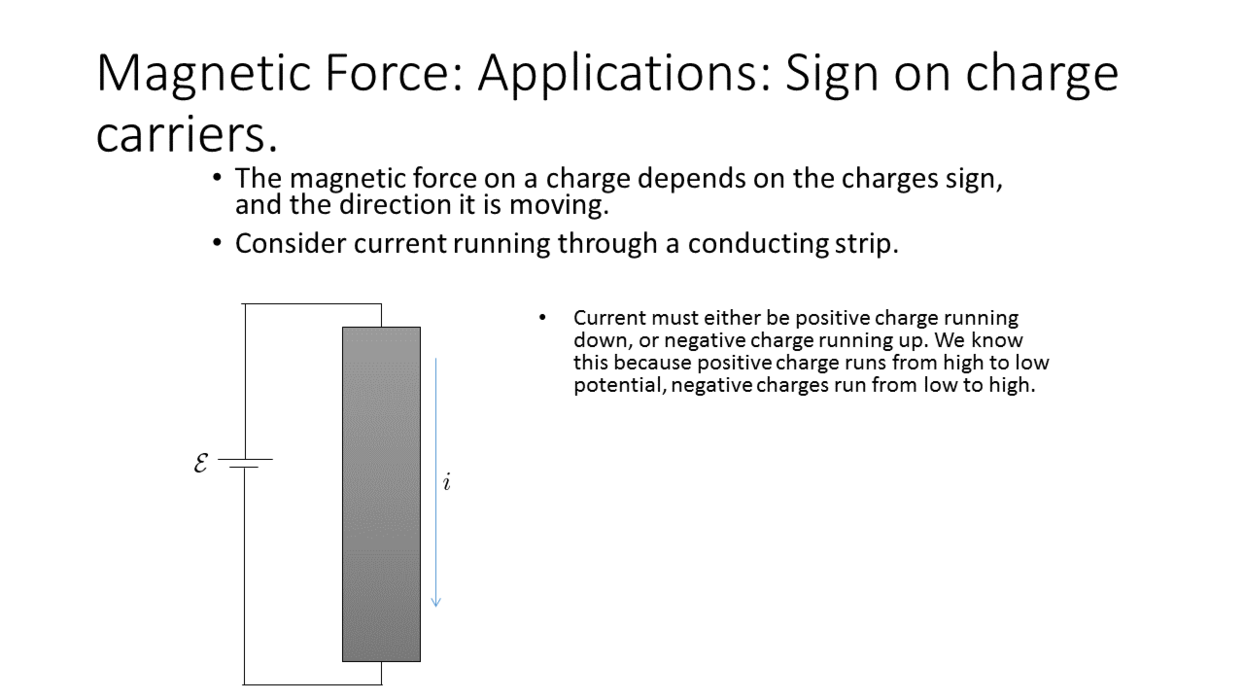
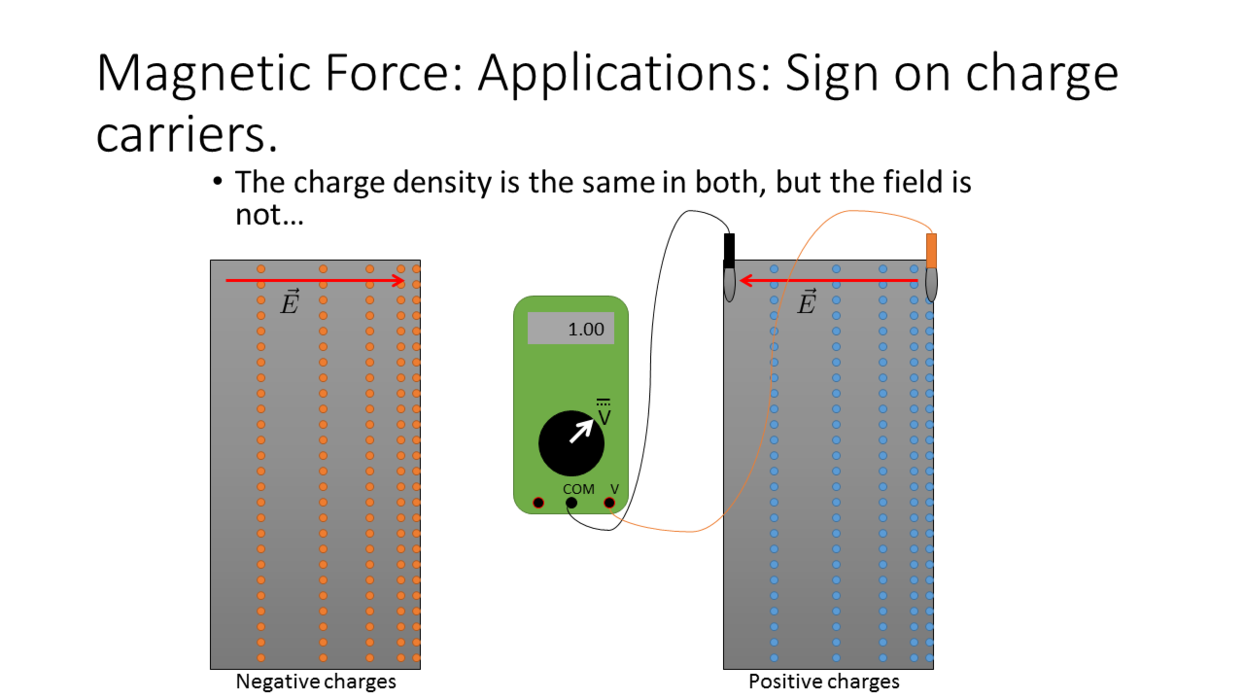
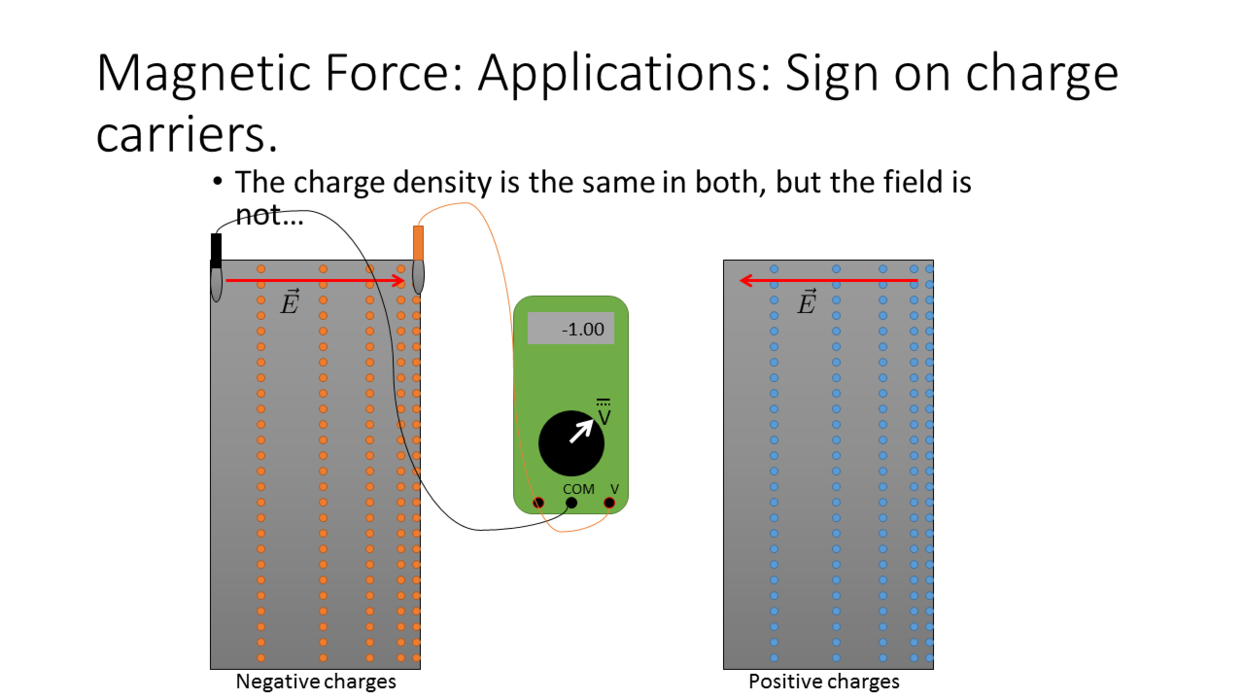
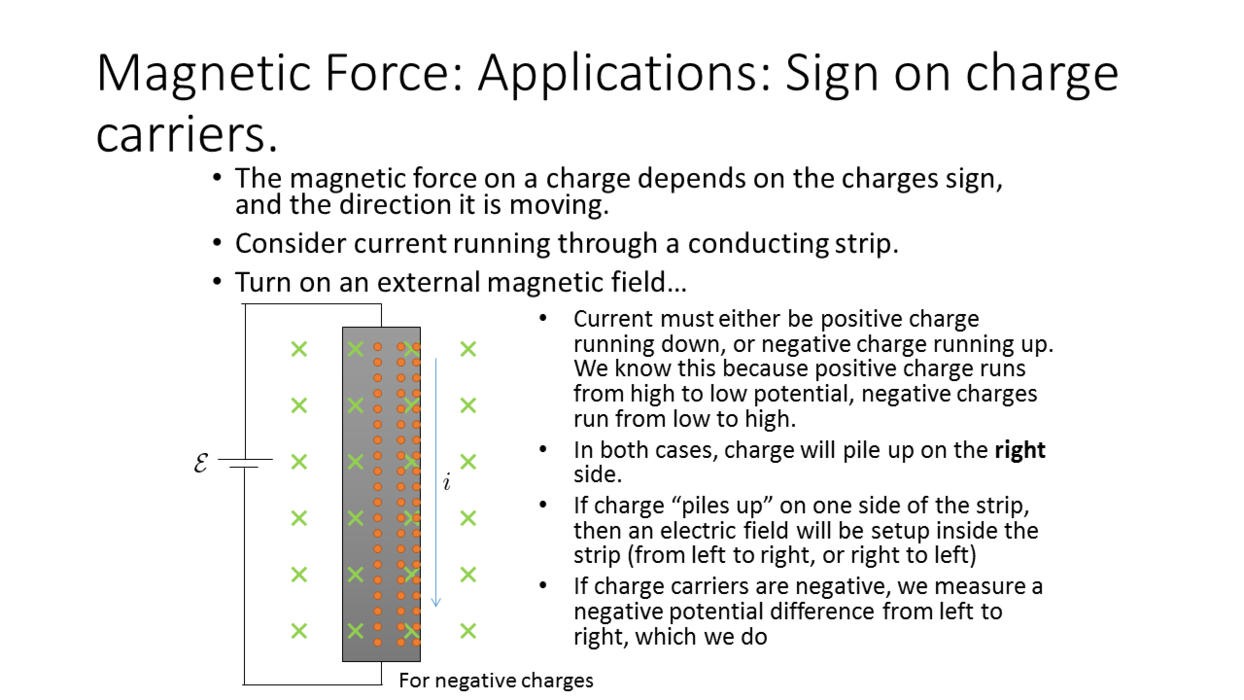
Hall Effect
_
_
_
_
_
_
_
_
_
_
_
_
Last Slide
Last Slide
Last Slide
Last Slide
_
_
_
_
_
_
_
_
_
_
_
_
_
Examples
Examples
_
_
Last Slide
Last Slide
Last Slide
Last Slide
Last Slide
Last Slide
Last Slide
Last Slide
Last Slide
_
_
Electric Motor
A DC motor works by running current through a loop of wire placed in
a magnetic field. The magnetic field exerts a torque on the loop, which
can be used to turn a axle. For a DC motor, the direction of the current
must be flipped every half rotation to keep the motor rotating in the
same direction.
Determine the torque produced by a simple DC motor constructed of 2
cm diameter coil of wire consisting of 100 loop (or turns) with 200 mA
of current if it spins at 60 rpm.
Last Slide
Last Slide
No really, that was the last one.
Last Slide
There is nothing to see here!
Last Slide
Look, I know that the slide count says there are more slides, but
there aren’t any more.
Last Slide
Seriously, its just a bunch of Last Slide slides.
Last Slide
This is the last one that says anything funny. You can stop clicking
now.
Last Slide
Last Slide
Last Slide
Last Slide
Last Slide
Last Slide
Last Slide
Last Slide
Last Slide
Last Slide
Last Slide
Last Slide
Last Slide
Last Slide
Last Slide
Last Slide
Last Slide
Last Slide
Last Slide
Last Slide
Last Slide
Last Slide
Last Slide
Last Slide
Last Slide
Last Slide
Last Slide
Last Slide
Last Slide
Last Slide
Last Slide
Last Slide
Last Slide
Last Slide
Last Slide
Last Slide
Last Slide
Last Slide
Last Slide
Last Slide
Last Slide
Last Slide
Last Slide
Last Slide
Last Slide
Last Slide
_
_
_
_
Cross Product Refresh
We have multiple ways to calculate the cross product between two
vectors (\(\vec{a} \times
\vec{b}\)):
use \(ab\sin\theta\) for the
magnitude and determine the direction using the right-hand rule
the determinant method
using the cross product between the three unit vectors (\(\hat{x}, \hat{y}, \hat{z}\))
Example:
What is the cross product between \(\vec{u} = 2\hat{x} + 2\hat{y}\) and \(\vec{v} = 1\hat{x} - 2\hat{y}\)?
What is the cross product between \(\vec{u} = 1\hat{x} - 2\hat{y}\) and \(\vec{v} = -1\hat{x} + 3\hat{z}\)?
Right-Hand Rules
We will be using many different right-hand rules over the next
several weeks, so it is important that we get them all straight. In this
module alone, we will have a couple:
Cross product rules
magnetic force on charge
magnetic force on wire
torque
Area vector/current directions
Summary
Vector quantities
\(\vec{B}\) magnetic field
\(\vec{v}\) velocity of
charges
\(\vec{L}\) Length vector
\(\vec{A}\) Area vector
\(\vec{\mu} = i\vec{A}\) Dipole
moment
\(\vec{\tau}\) torque
Equations
\(\vec{F}_B = q
\vec{v}\times\vec{B}\)
\(\vec{F}_B = i
\vec{L}\times\vec{B}\)
\(\vec{\tau}_B = i \vec{A}\times\vec{B} =
\vec{\mu}\times\vec{B}\)
Lorentz Force
If a charge moves through a region of electric and magnetic field,
both field exert a force on the charge.
Magnetic Force: \(\vec{F}_B = q \vec{v}
\times \vec{B}\)