Last Updated: Sun May 31 09:18:17 CDT 2020
What is a Capacitor?
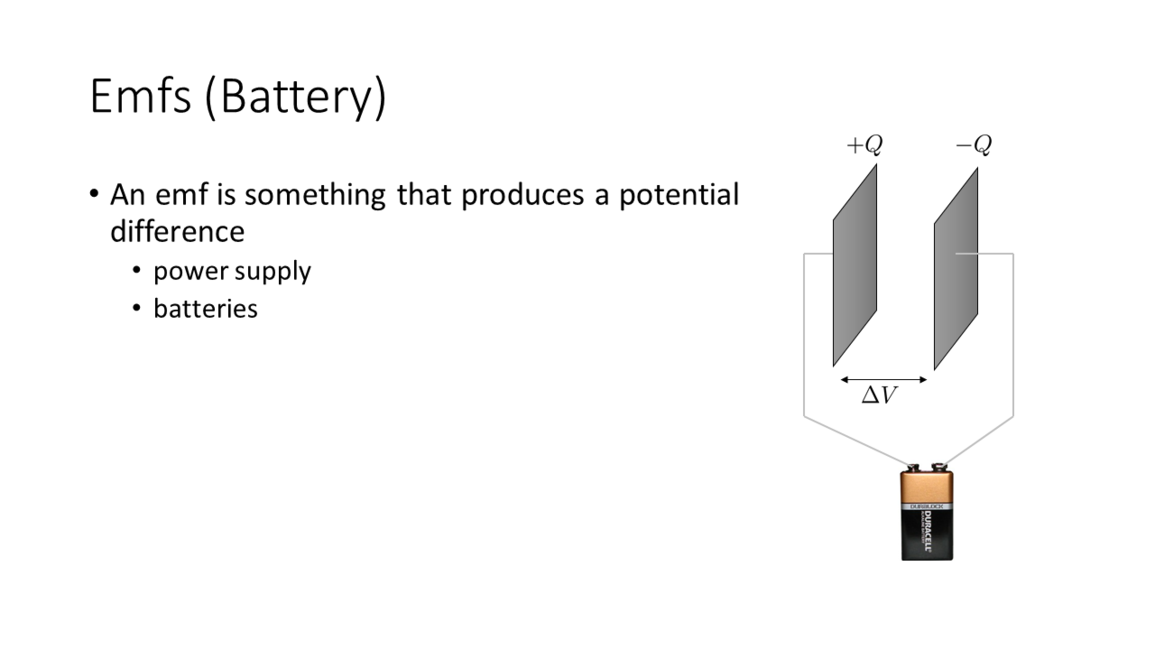
A capacitor stores charge
Our Job
- Understand the physics of capacitors (how they work)
- Understand the behavior of capacitors in a circuit (how they are used)
How they work…
\(Q = CV\)
This is the general definition of capacitance…
\(C = Q/V\)
The charge a capacitor can store, divided by the potential difference applied, is its capacitance.
Demo: Let’s charge some capacitors
NOTE about \(V\) and \(Q\) for capacitors
\(Q = CV\) actually means \(|Q_\text{one plate}| = C \Delta |V_\text{between plates}|\)
How much charge does this giant thing store?
Label says 89000 microfarad…
What is the capacitance of the Van de Graaff Generator?
The Van de Graaff generator had much less charge on it. That’s because it has a much smaller capacitance.
Recall: \(\approx 2.48\times 10^{-5}\text{C}\) for \(1.5\times 10^6 \text{V}\).
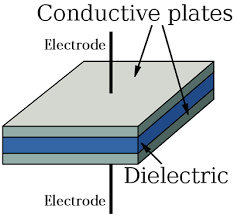
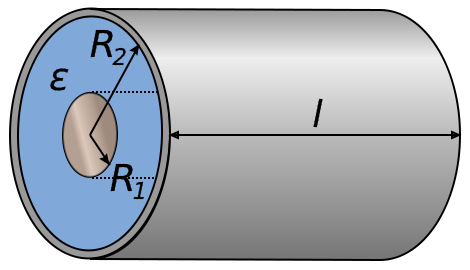
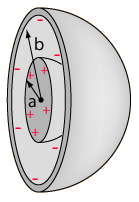
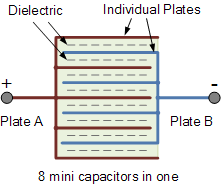
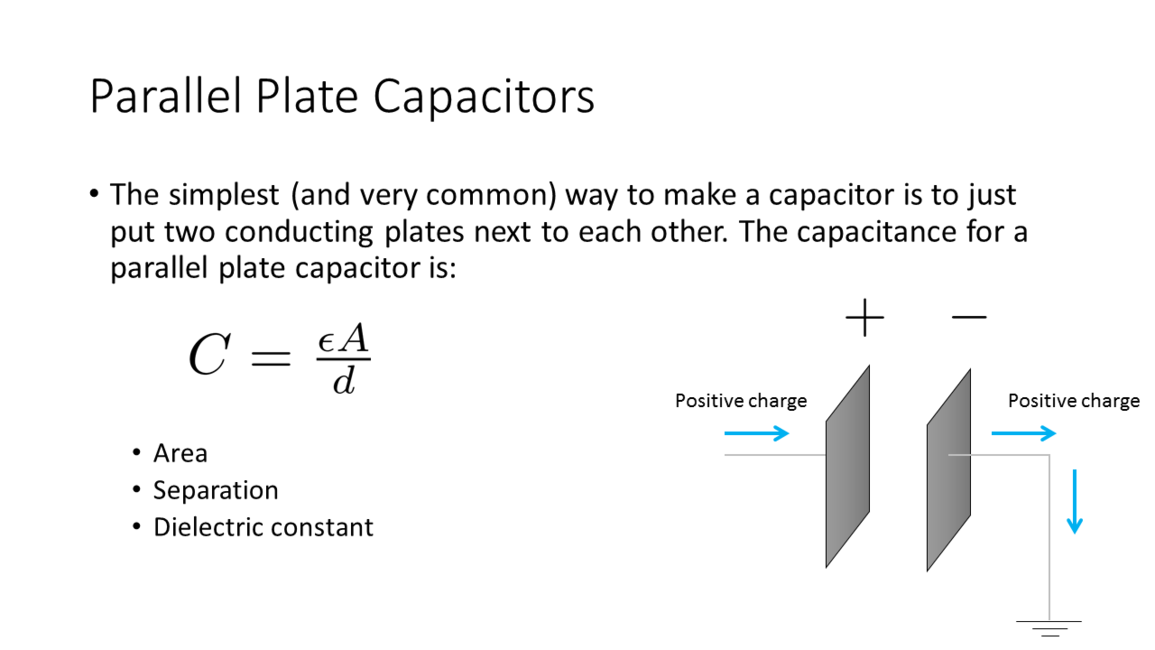
The capacitor contains plates…
The capacitor contains plates…
_
_
Permittivity
\(\epsilon\) is called the “permittivity”
\(\epsilon_0\) is the “permittivity of free space”
\(\epsilon_0 = \frac{1}{4\pi k}\)
The permittivity of any material is greater than the permittivity of free space, and can be written as
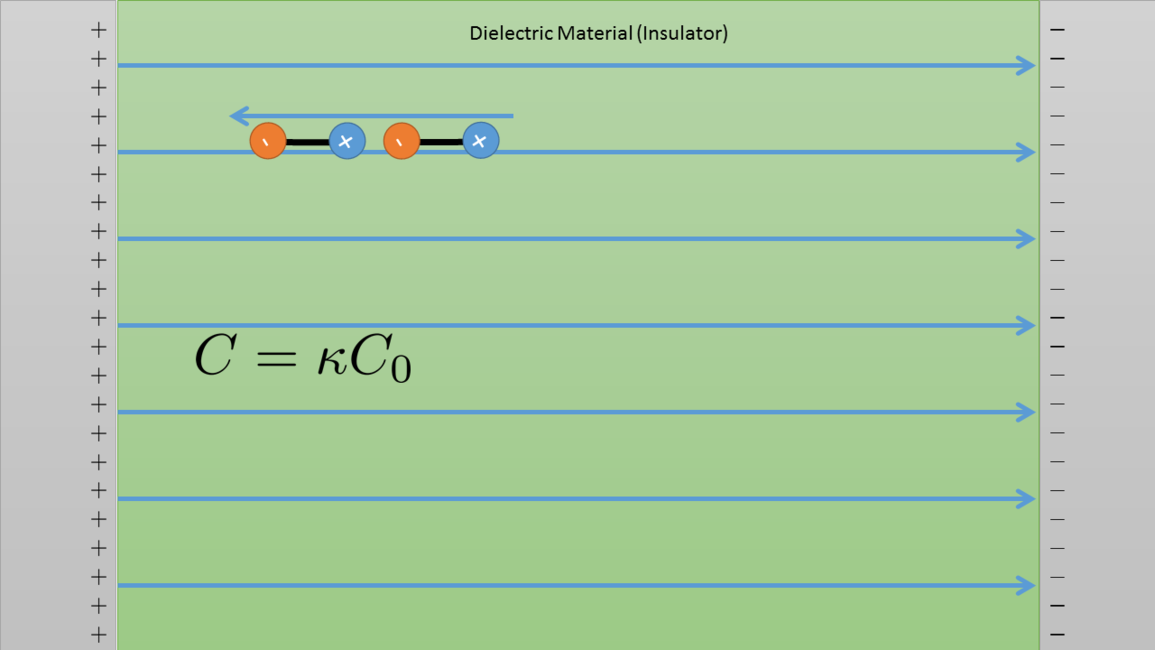
\(\epsilon = \kappa \epsilon_0\)
where \(\kappa\) is the “dielectric constant”
Different materials have a different dielectric constants:
- Teflon : 2.1
- Paper : 2.8
- Silicon : 11.68
Field between the plates
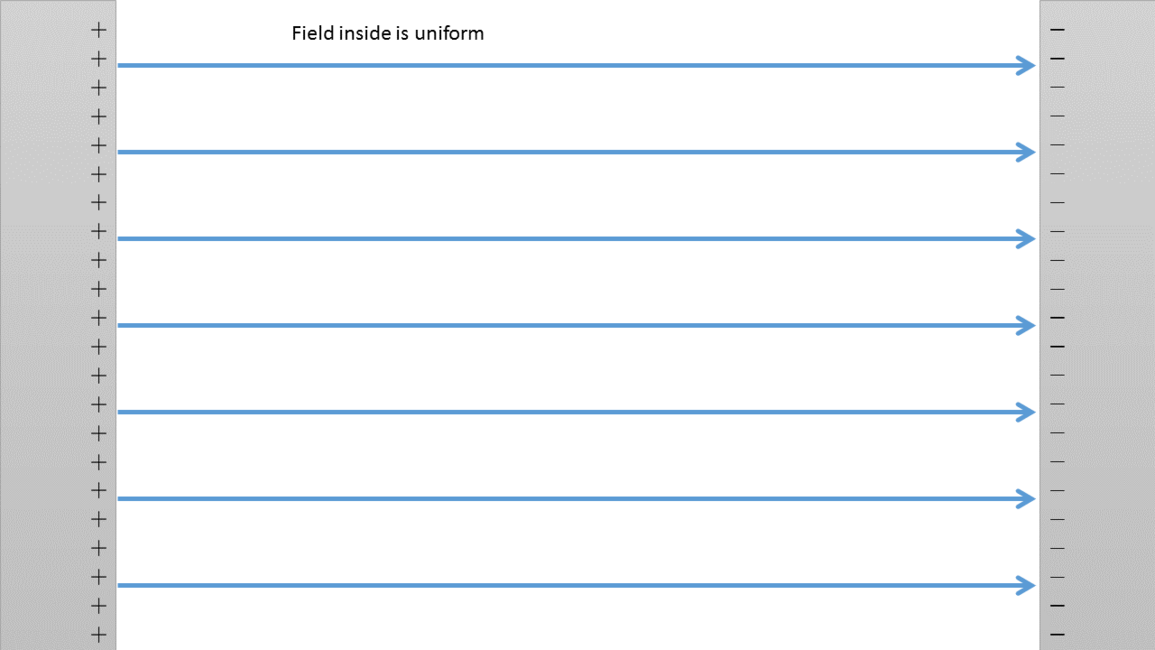
In this class, we will always assume that the field between the two plates of a capacitor is uniform.
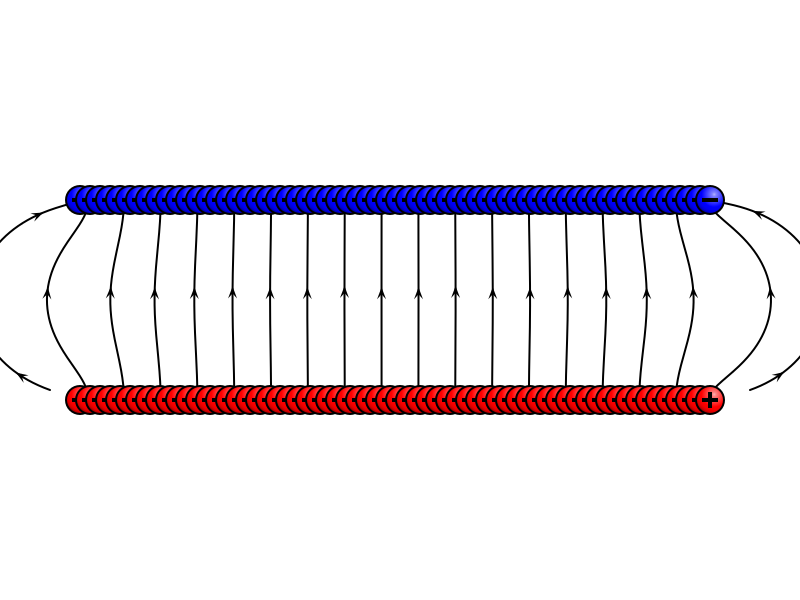
Let’s look at the field inside the capacitor
Remember, \(\Delta V = -\vec{E} \cdot \Delta \vec{r}\) (for uniform fields)
For parallel plate capacitor, \(\Delta V = \pm E d\)
_
_

Hold voltage constant (with power supply) and make the plates smaller.
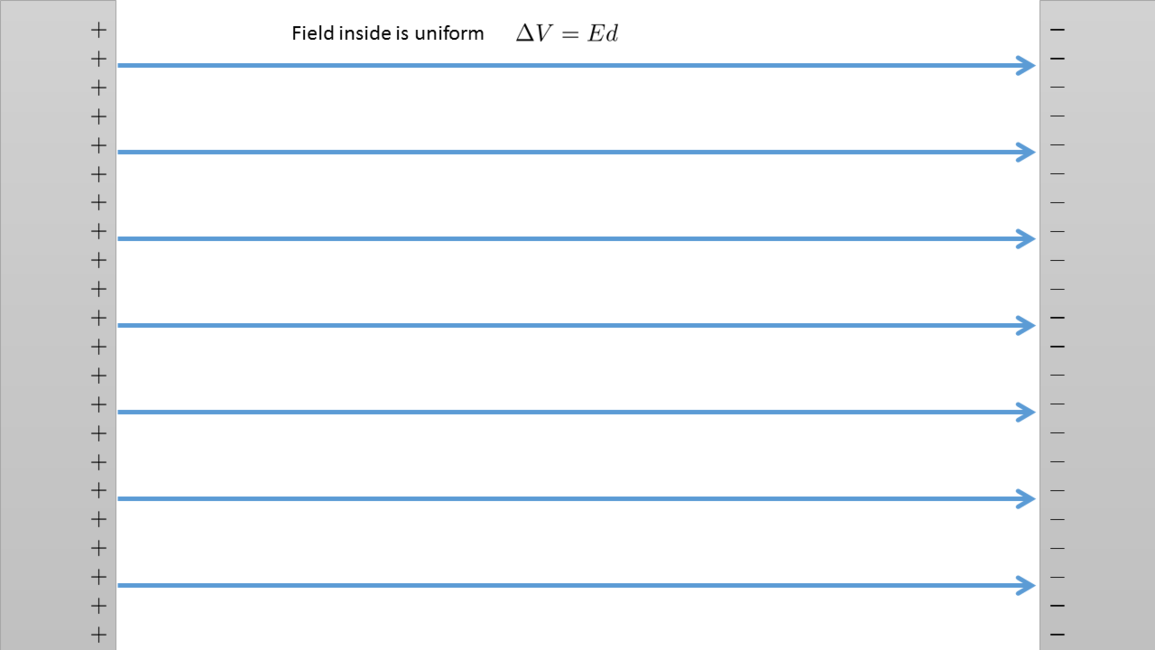
Hold voltage constant (with power supply) and make the plates smaller.
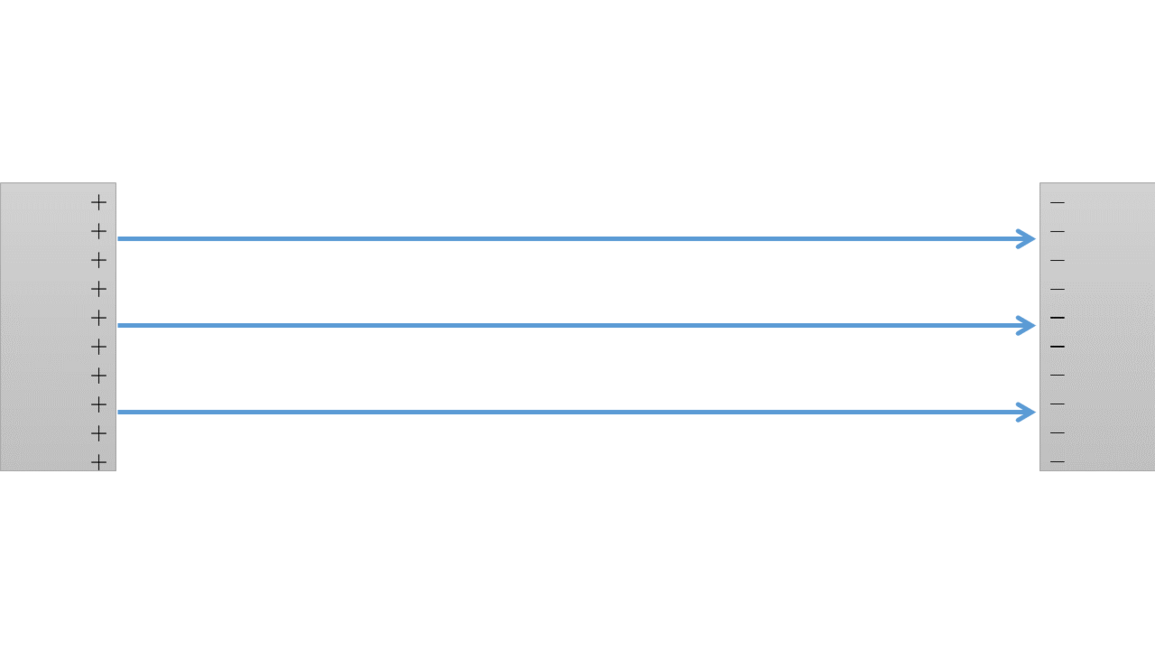
What happened?
- \(V\) is held constant.
- \(d\) did not change
- so \(E\) did not change
- but \(Q\) decreased
So, \(C = \frac{Q}{V}\) must go down.
OK, so if I make the plates smaller, the capacitance goes down. That makes sense.
Hold voltage constant (with power supply) and bring plates closer together.
Hold voltage constant (with power supply) and bring plates closer together.
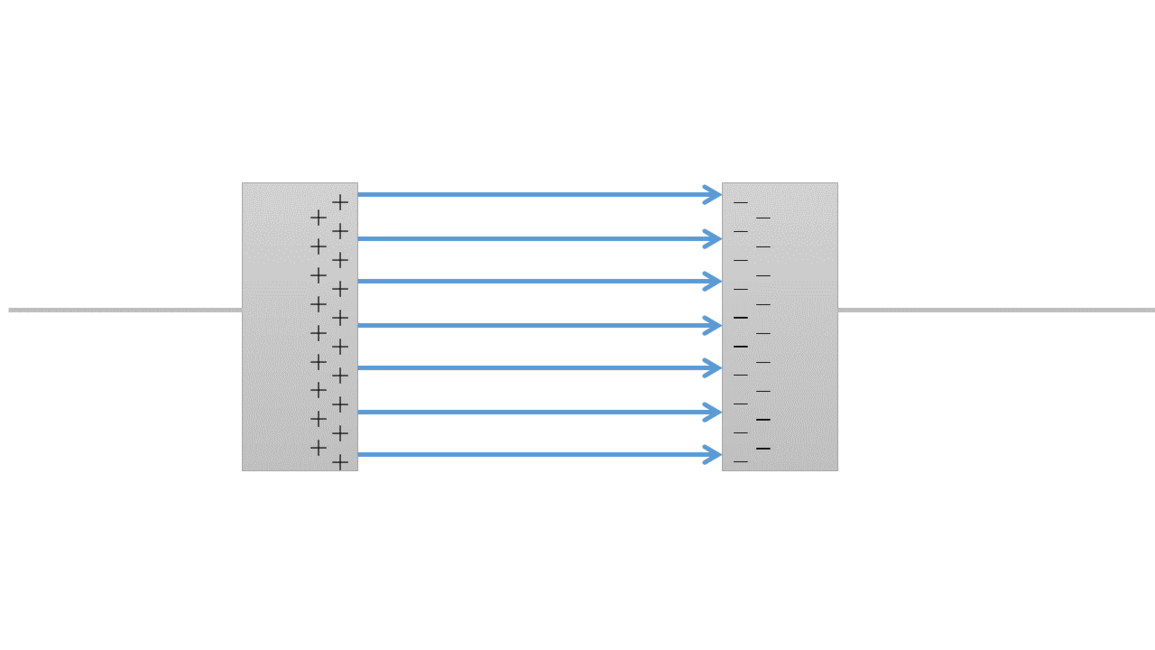
What happened?
- \(V\) is held constant.
- \(d\) decreased
- so \(E\) must increase
- and \(Q\) can increase
So, \(C = \frac{Q}{V}\) must go up.
What does the dielectric do?
Remove capacitor from voltage source and put a dielectric material inside.
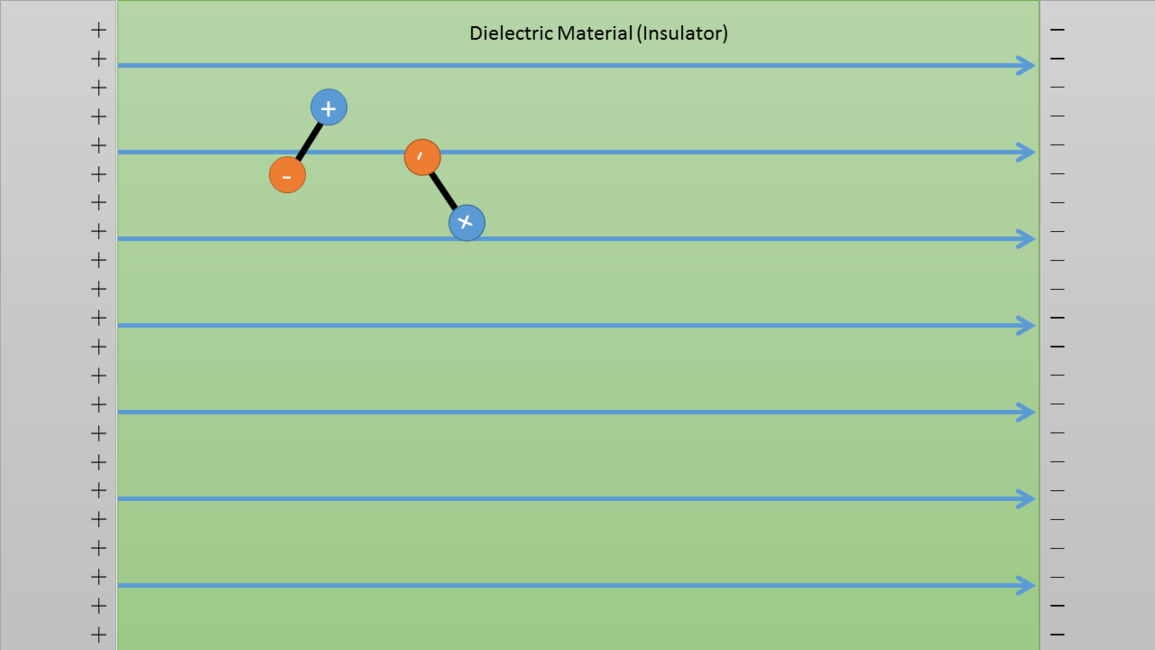
Remove capacitor from voltage source and put a dielectric material inside.
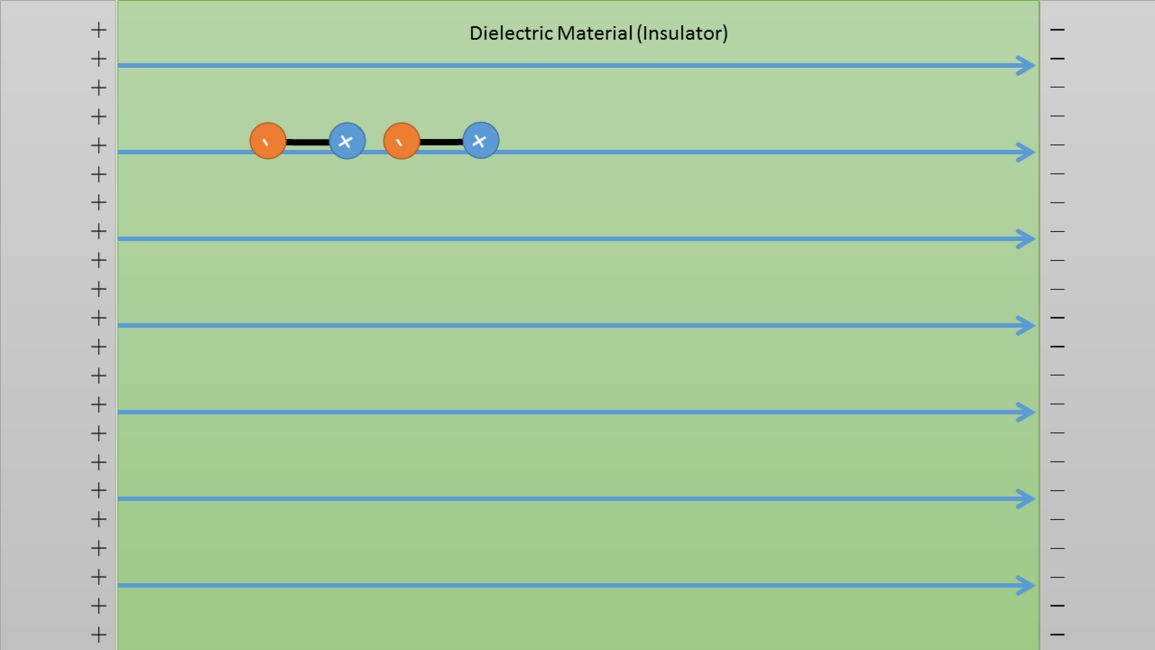
Remove capacitor from voltage source and put a dielectric material inside.
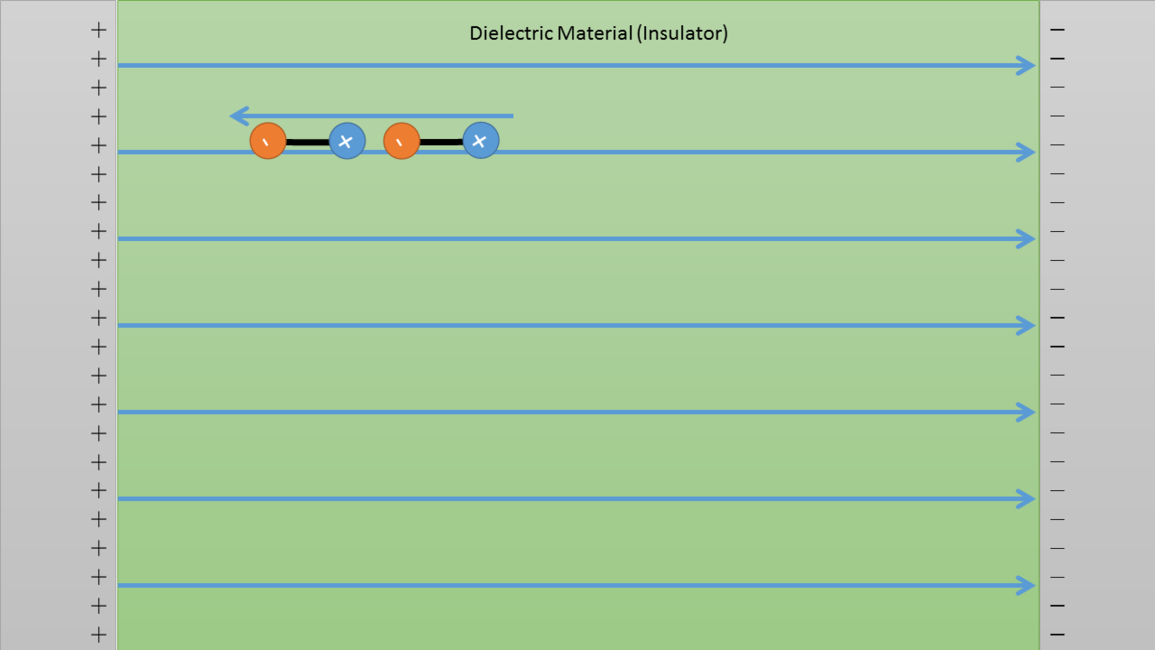
What happened?
- \(Q\) is held constant.
- \(d\) is held constant.
- electric field decreases.
- so \(V\) must decrease
So, \(C = \frac{Q}{V}\) must go up.
_
_
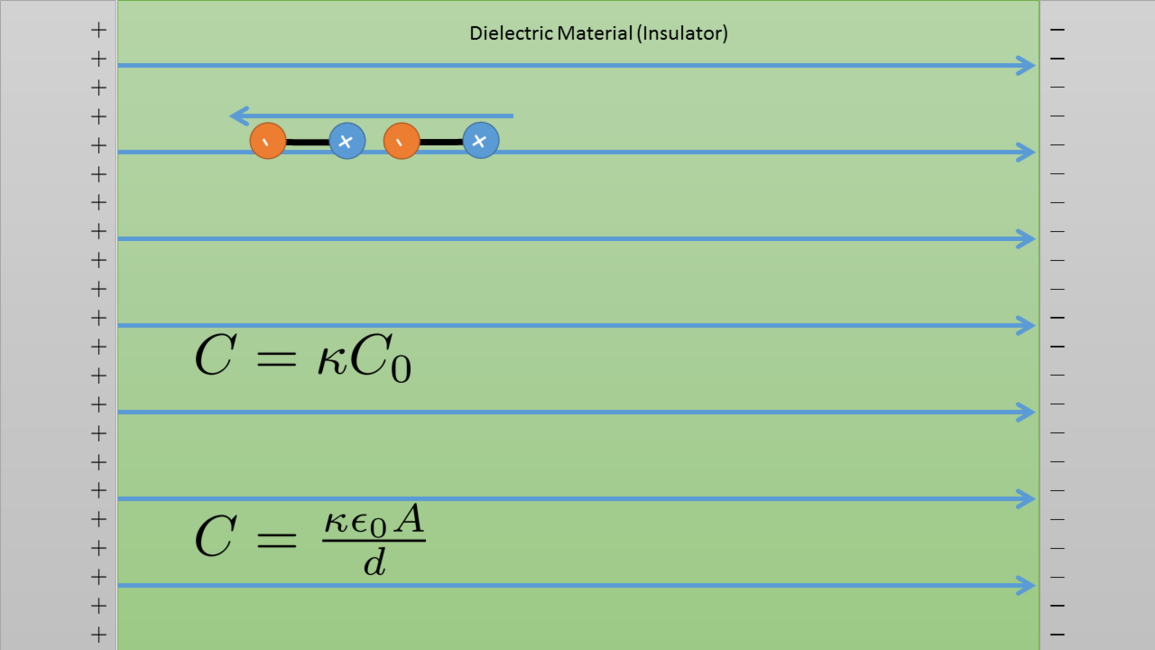
OK, so there are 3 ways to change the capacitance of a parallel plate capacitor.
- Plate size
- Plate separation
- Dielectric material
_
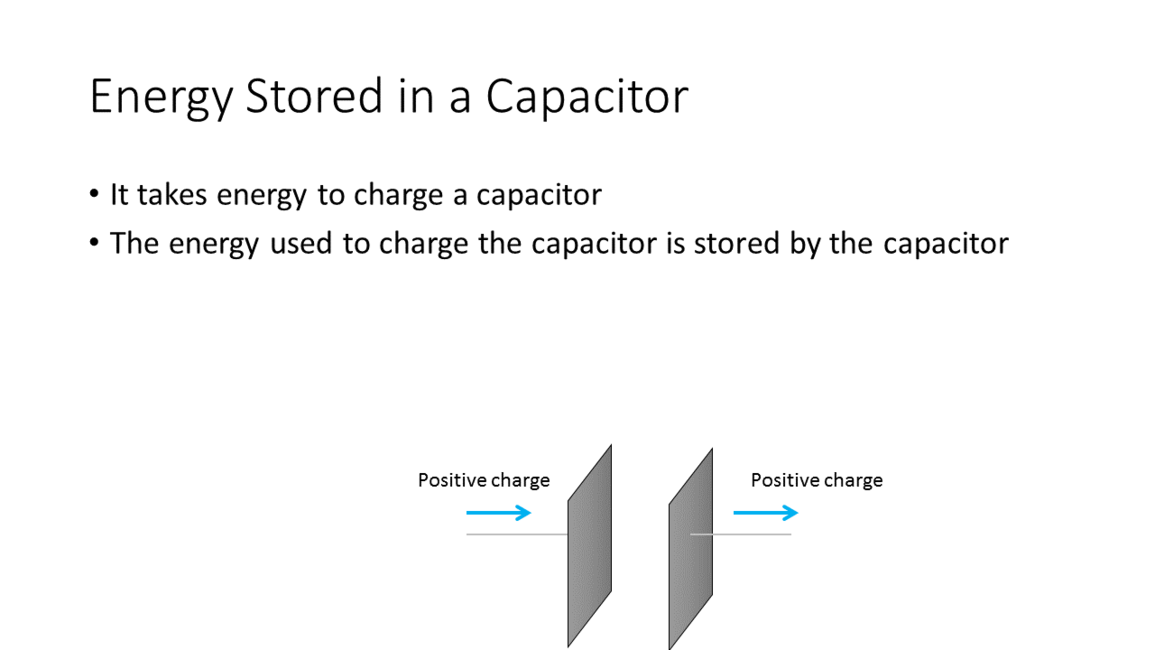
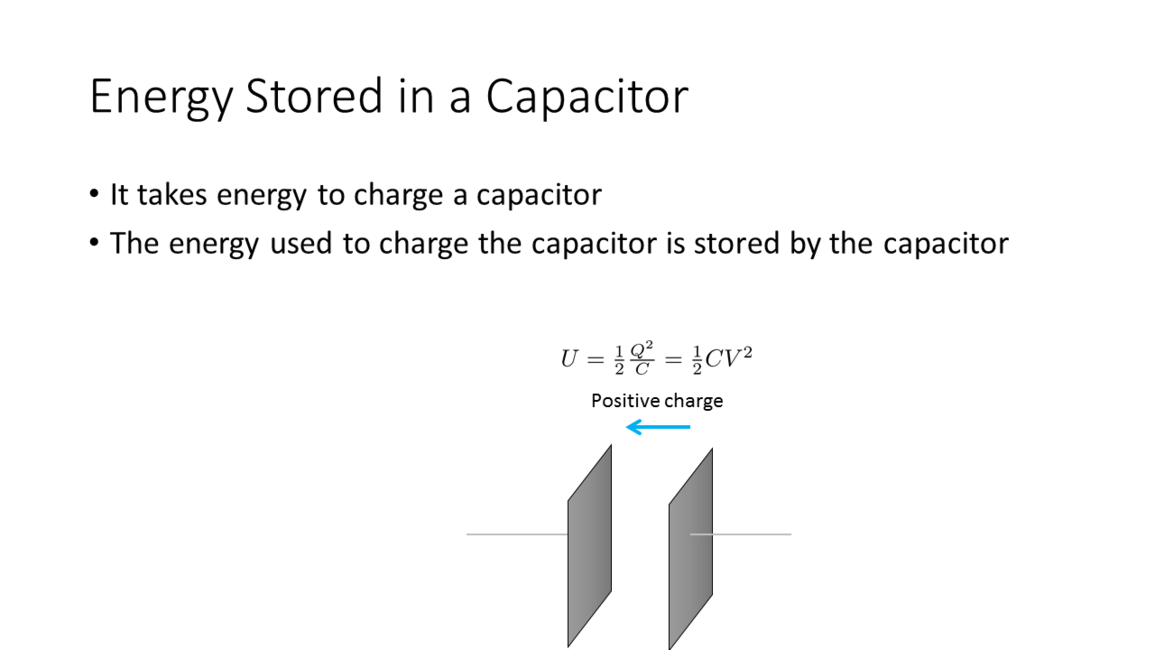
How much work does it take to charge the capacitor?
_
_

Consider a simple parallel-plate capacitor whose plates are given equal and opposite charges and are separated by a distance \(d\). Suppose the plates are pulled apart while the charge on the capacitor remains constant, until they are separated by a distance \(D > d\). What will happen to the potential difference between the plates of the capacitor.
A. it will increase
B. it will decrease
C. it remain the same
Consider a simple parallel-plate capacitor whose plates are given equal and opposite charges and are separated by a distance \(d\). Suppose the plates are pulled apart while the charge on the capacitor remains constant, until they are separated by a distance \(D > d\). What will happen to the energy stored in the capacitor?
A. it will increase
B. it will decrease
C. it remain the same
Consider a simple parallel-plate capacitor whose plates are given equal and opposite charges and are separated by a distance \(d\). Suppose the plates are pulled apart while the potential difference across the capacitor remains constant, until they are separated by a distance \(D > d\). What will happen to the energy stored in the capacitor?
A. it will increase
B. it will decrease
C. it remain the same
_
_
_
_
_
_
_
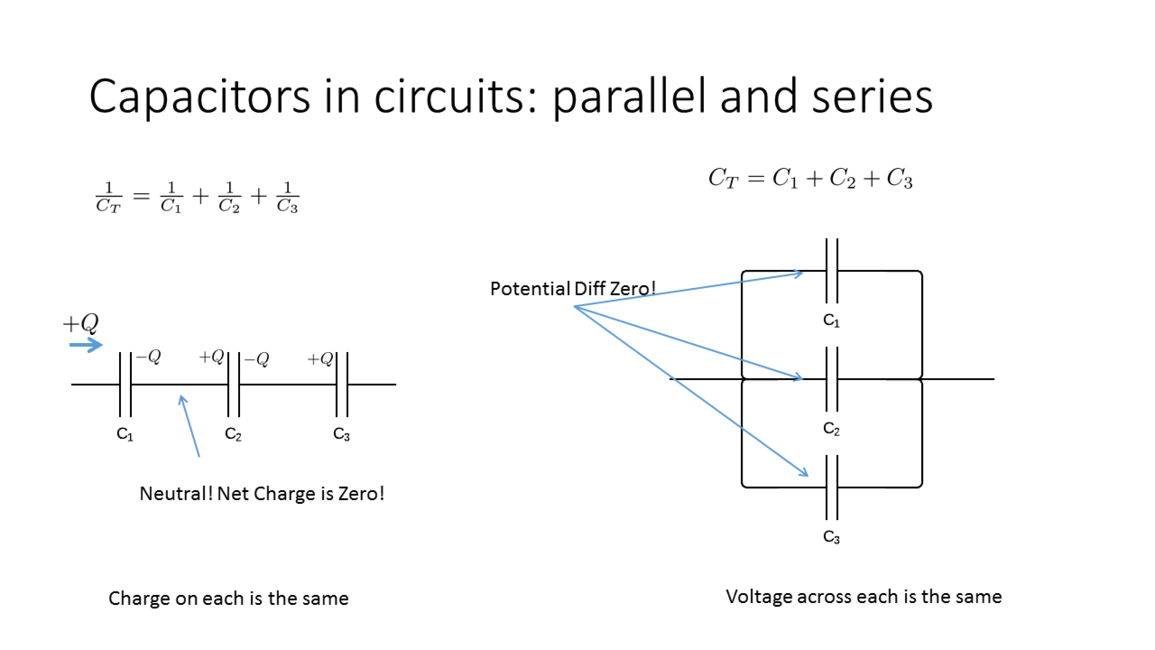
Effective Capacitance
Different textbooks use different terms for capacitance of a group of capacitors.
- Effective Capacitance
- Total Capacitance
- Equivalent Capacitance
These mean the same thing.
Let’s charge these two capacitors…
What is the potential difference across the capacitors?
Parallel/Series Combinations
Consider the circuit below.
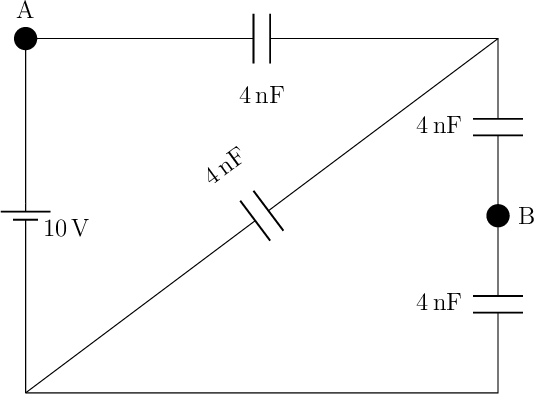
- Determine the charge on, and the voltage across, each capacitor.
- What is the effective capacitance of the circuit?
- What is the potential difference between points \(A\) and \(B\)? Which point is at higher potential?
- If the capacitor in the middle were removed, what would happen to the charge on the top capacitor?
- If the capacitor in the middle were replaced by a wire, what would happen to the charge on the top capacitor?
- The potential difference between any two points in a circuit is equal to the sum of potential differences across the components between the two points along any path.
- The potential difference between any two points in a circuit does not depend on that taken between them.
- The potential across an emf is constant (i.e. it is set by the emf).
_
_
_
_
_
_
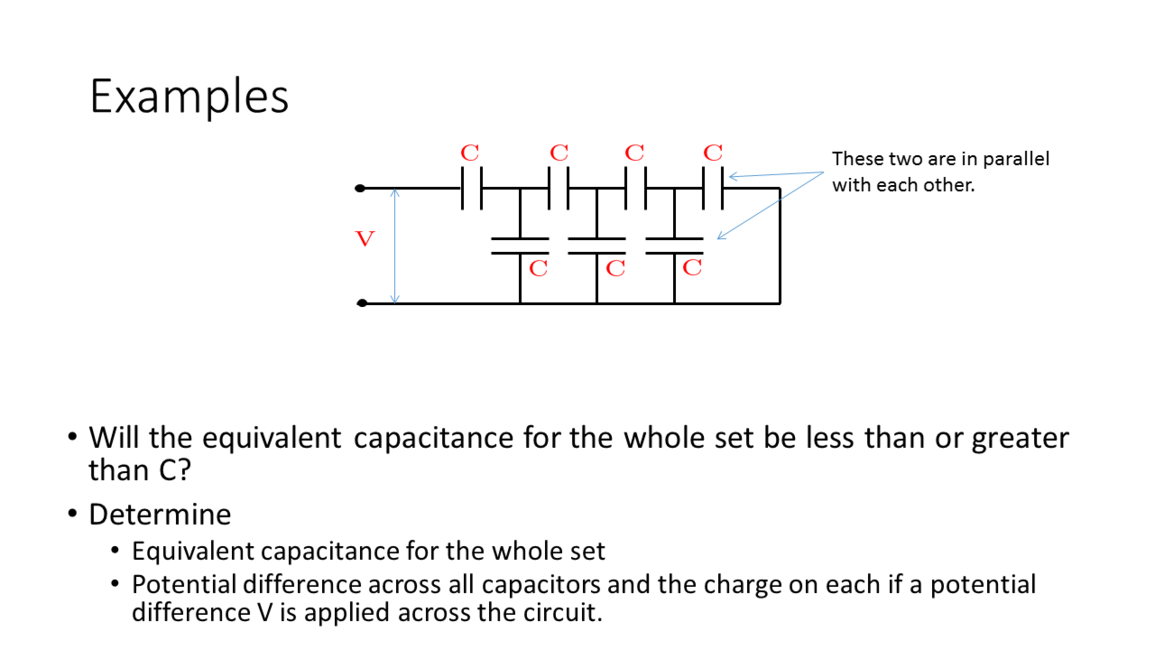
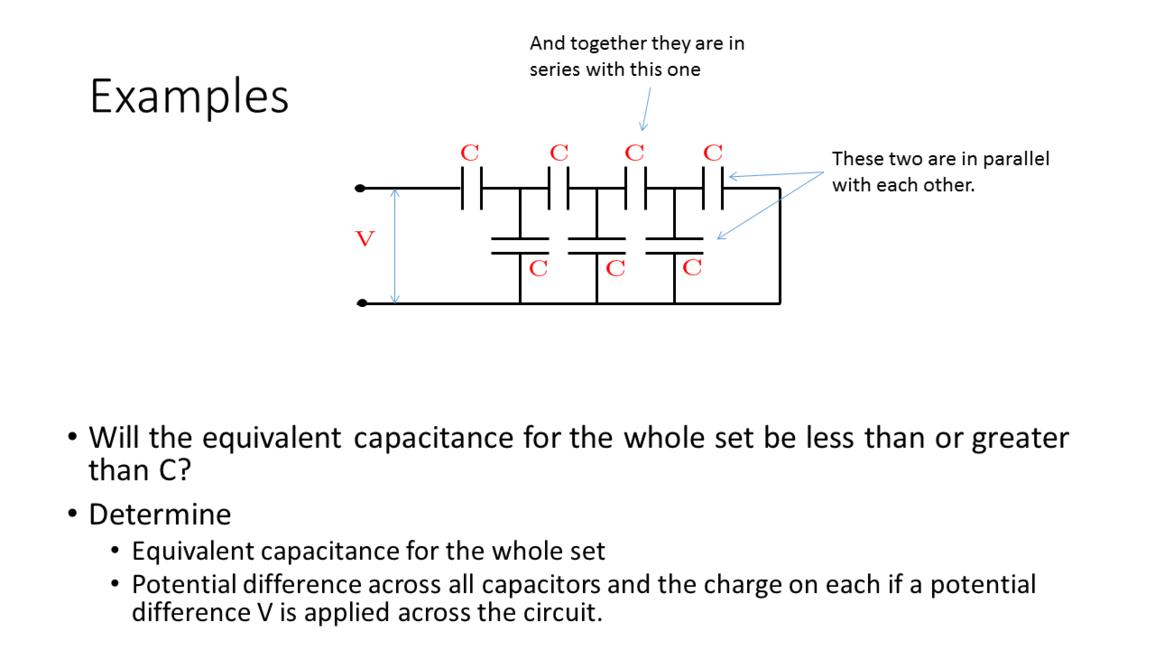
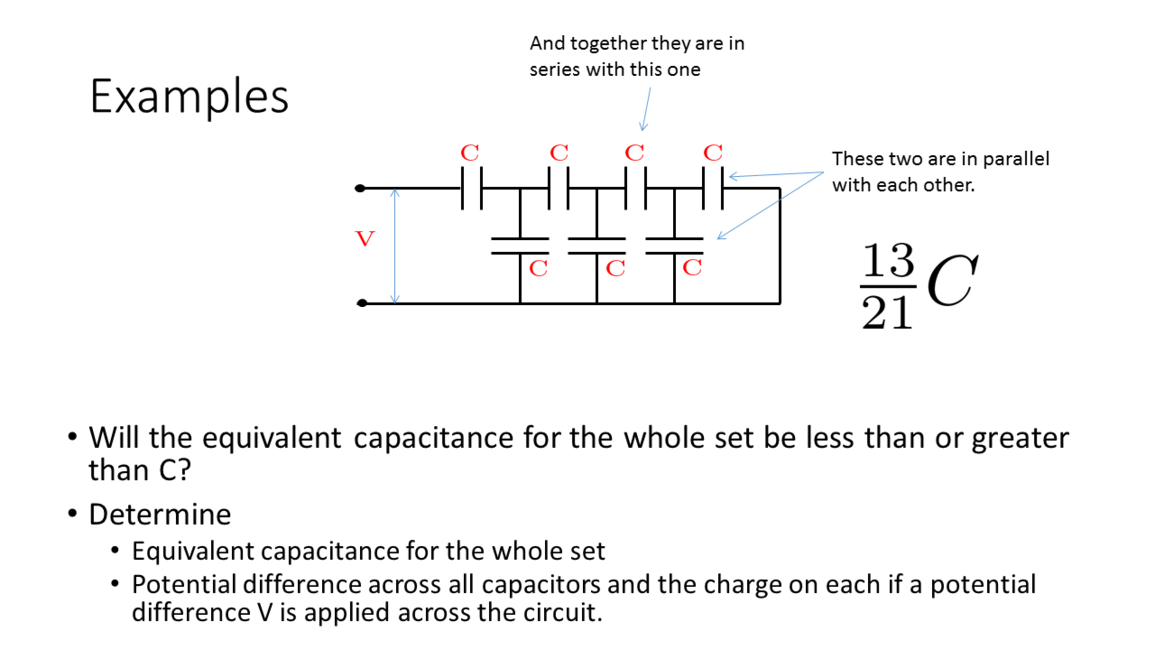
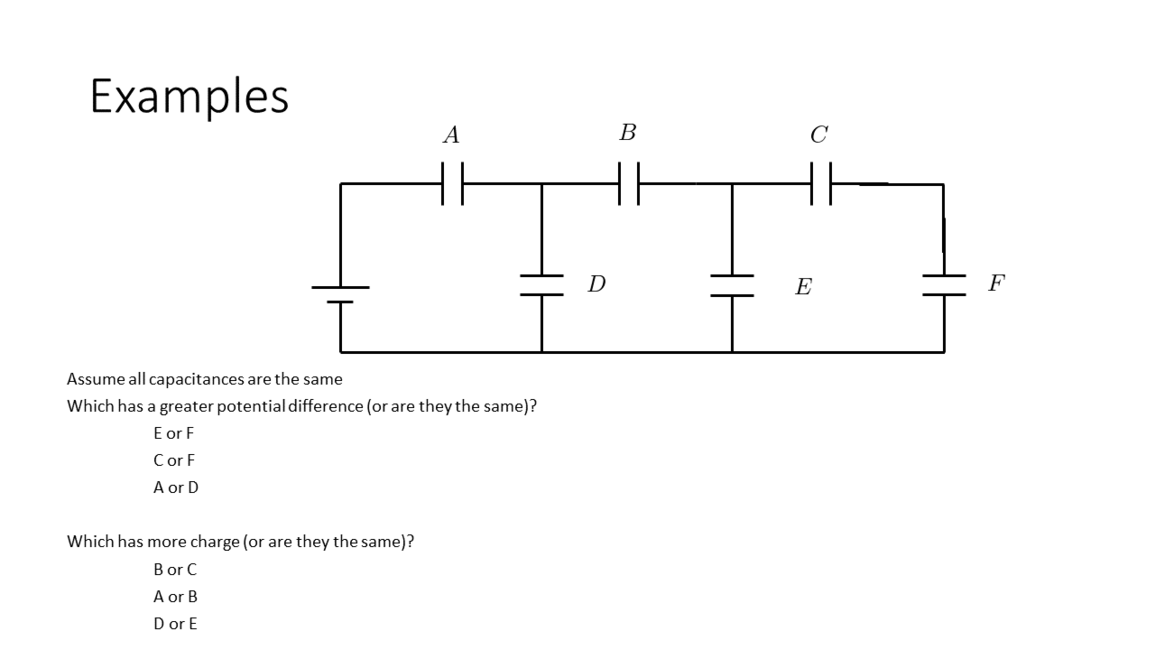
Examples
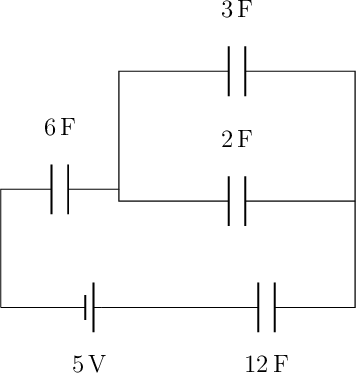
Determine:
- The equivalent capacitance of the four capacitors.
- The charge on each capacitor.
- The potential difference across each capacitor.
\(C_{eff} = \frac{20}{9} \text{F}\)
| Q |
100/9 C |
60/9 C |
40/9 C |
100/9 C |
| V |
50/27 V |
60/27 V |
60/27 V |
25/27 V |
Assume that all capacitors are parallel plate capacitors, filled with air, with identical plates. If the voltage of the emf were slowly increased, which capacitor would reach its breakdown limit first?
_
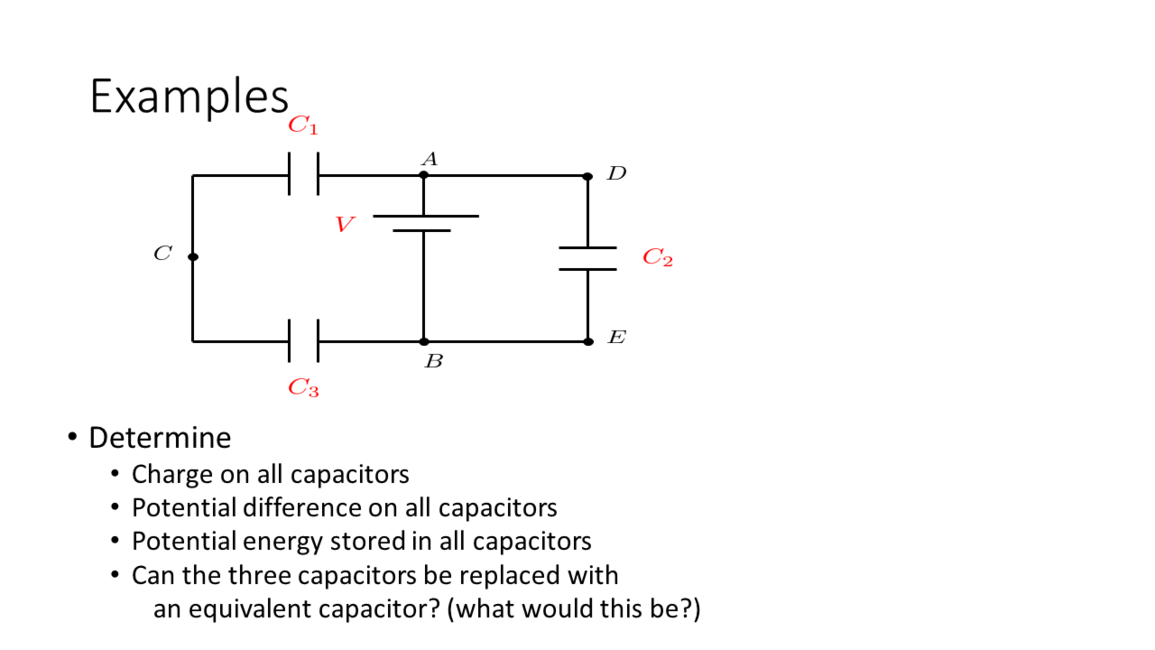
_
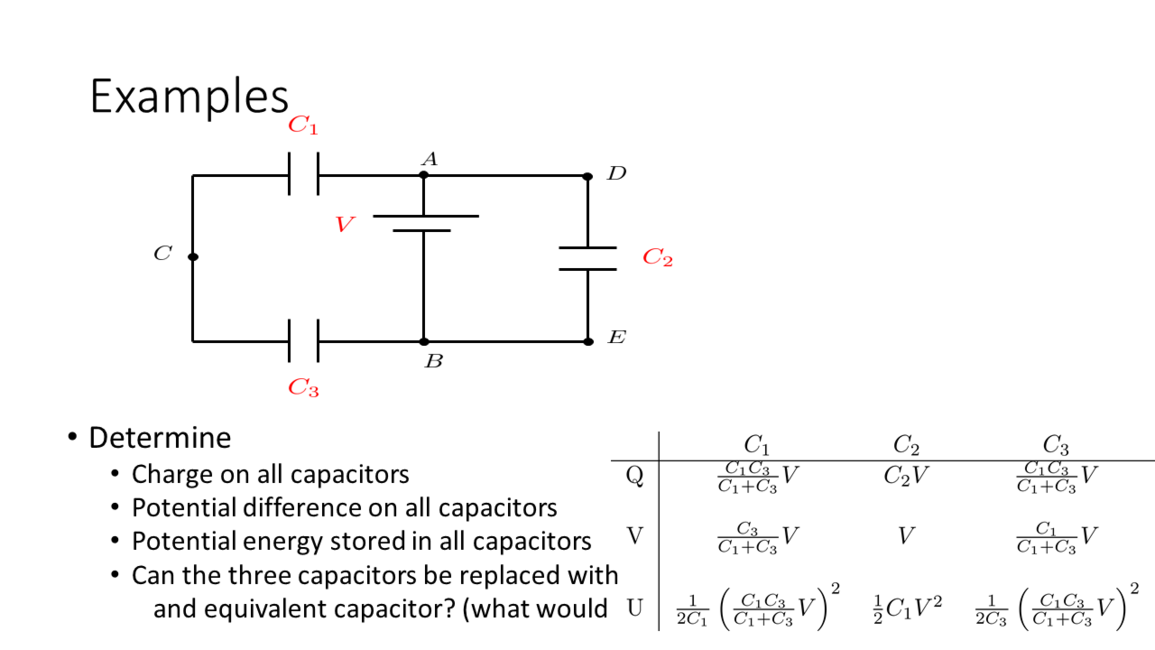
_
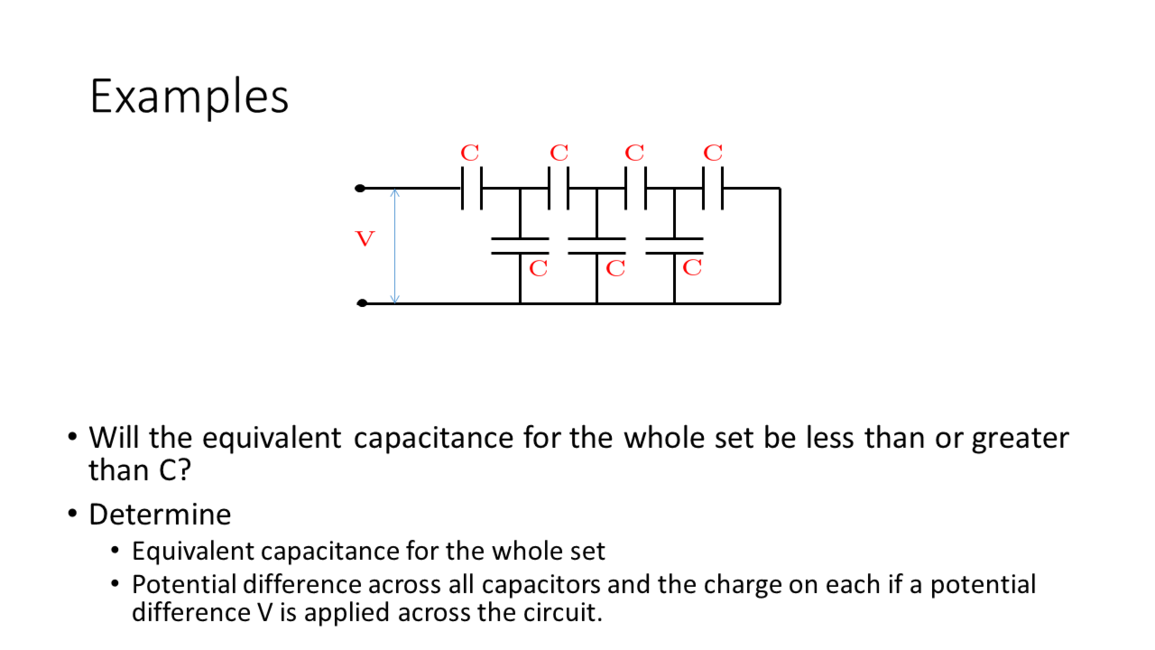
_
 ~
~
_
_
Examples
Consider the following experiment:
- Take two capacitors, one with capacitance \(C_1\), the other with capacitance \(C_2\).
- Connect the two capacitors together in series.
- Apply a voltage, \(\mathcal{E}\), across them.
- Disconnect the capacitors
- Connect the positive terminals together and the negative terminals together.
What will the potential difference between the capacitor terminals be?
_
_
Last Slide