Module 01
Electric Charge
Last Updated:
Baseline Quiz
- writing utensil
- bubble sheet
- 6 minutes
Questions
- How do we know charge exists?
- How do we know there are positive and negative charges?
Demo
- How would I go about getting charge onto insulators and conductor?
- Friction - direct transfer of charge from one insulator to another by friction.
- Conduction - direct transfer of charge from the charged conductor to another conductor.
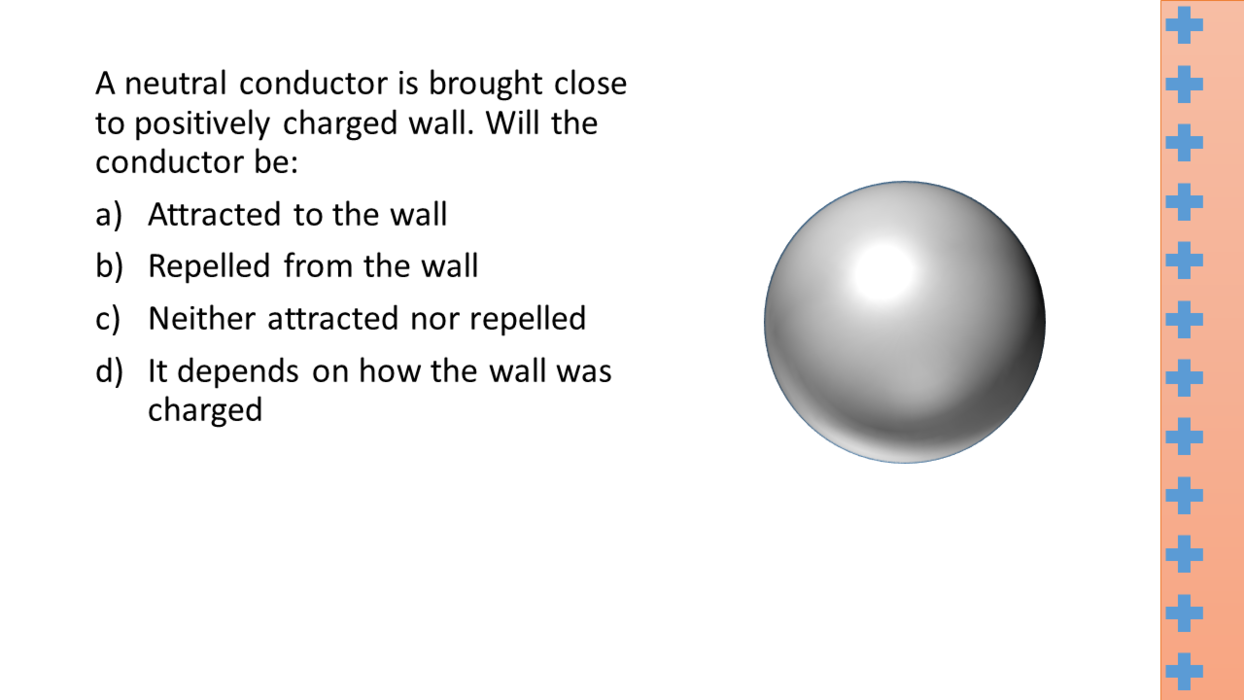
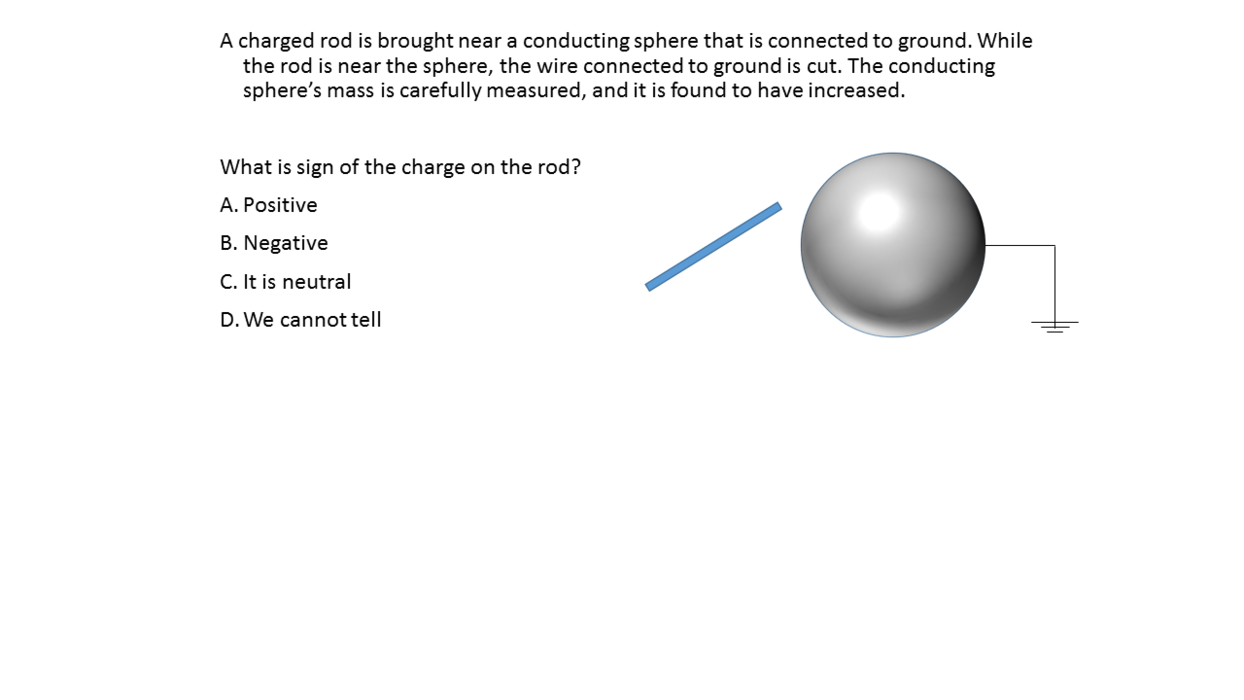
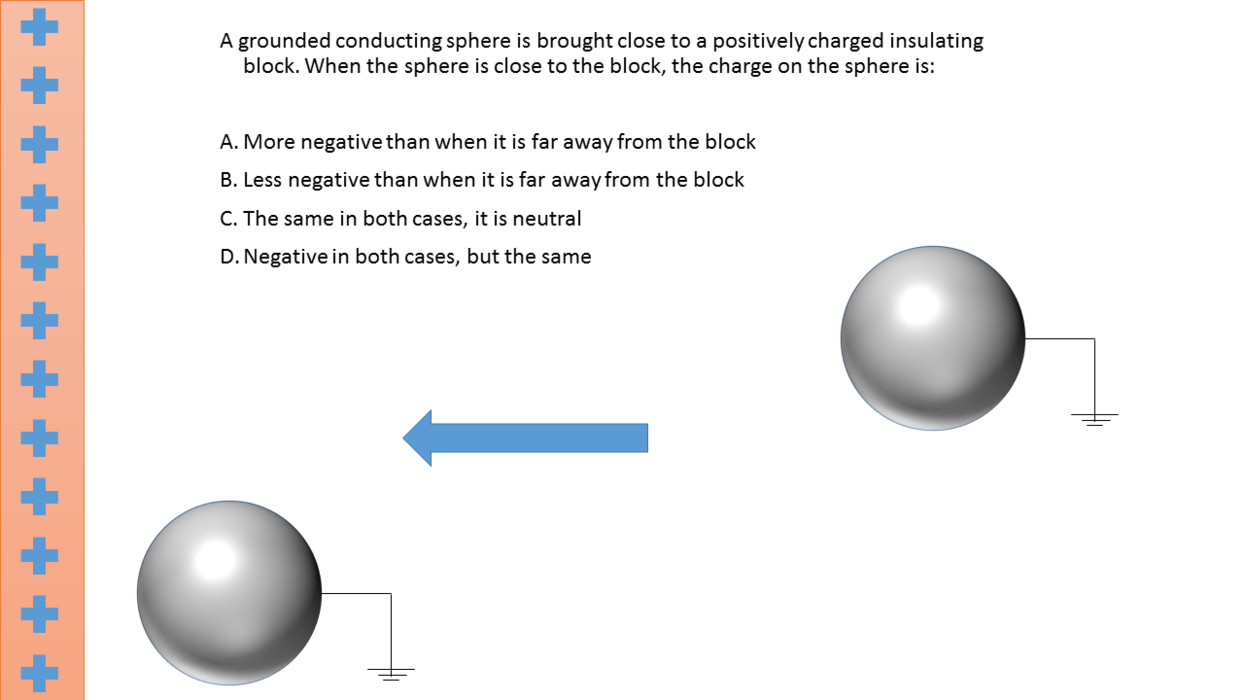
- Induction - neutral object charge is transferred to/from ground or another conductor due to induced polarization by a charged object.
- Pie Pan Example:
- By what processes is the pie pan charged?
- Why is the pie pan attracted to the Styrofoam even before it is charged?
- What happens when I “ground” the pie pan?
- Can I deplete charge from the insulator?
- How does the electroscope work?
- Why is paper attracted to both the Styrofoam and the pie pan?
- Van de Graaff Example
- Why is the ping pong ball attracted initially?
- Can I deplete charge from the Van de Graaff?
Conducting Spheres
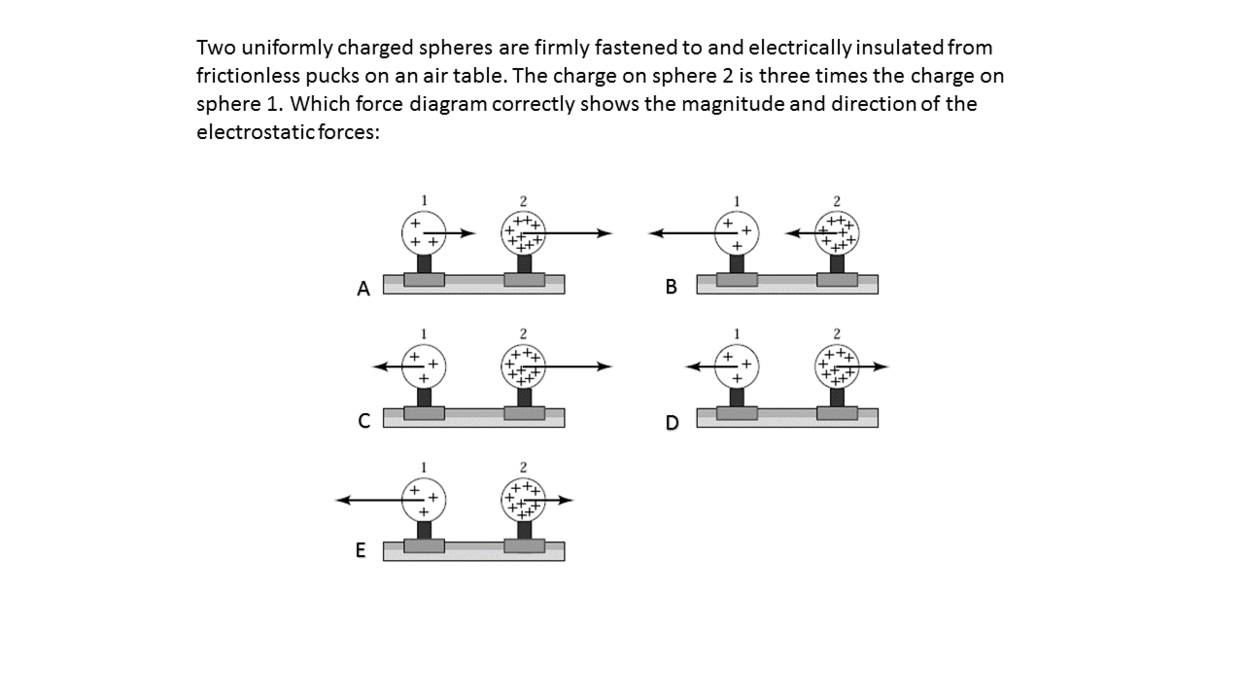
- What is the force between two conducting spheres that have excess charge on them?
- Will they be attracted or repelled?
- What if they were insulators?
- What if they were not spheres?
Charge of the electron
- The electron is negatively charged, but it is the charge carrier for electricity.
- This usually does not matter, until it does, and was actually difficult to prove.
Voting Cards
Three pithballs are suspended from thin threads. It is found that pithballs 1 and 2 attract each other and that pithballs 2 and 3 attract each other. What can we say must be true?
- 1 and 3 carry charges of opposite sign.
- 1 and 3 carry charges of equal sign.
- All pithballs have charges of the same sign.
- One of the objects carries no charge.
- We would need to do more experiments to determine if any of the above statements are true.
Three pithballs are suspended from thin threads. It is found that pithballs 1 and 2 repel each other and that pithballs 2 and 3 repel each other. What can we say must be true?
- One of the objects carries no charge.
- All pithballs have charges of the same sign.
- 1 and 2 carry charges of opposite sign.
- 2 and 3 carry charges of opposite sign.
- We would need to do more experiments to determine if any of the above statements are true.
A conductor with of charge is briefly brought into contact with a second identical conductor with of charge. After the two touch, they will:
- Attract each other
- Repel each other
- Neither Attract or repel each other.
_ 
_ 
_ 
_ 
_ 
Examples
Coulomb’s Law
Coulomb’s Constant
Coulomb’s constant, \(k\), is related to the permittivity of free space \(\epsilon_0\).
Both constants are commonly used, so your book may use either (or both).
Example
A conducting sphere of radius has an excess charge of on it. A second conducting sphere with radius has an excess charge of on it. The two spheres are brought into contact and then placed apart (surface to surface). Determine the force exerted on the second sphere.
Coulomb’s Law in 2 or more dimensions
Recall: Forces are vectors.
Review: Vectors
- Vectors have a magnitude and direction.
- Vectors have “components”.
- When adding vectors, we must add their components.
- There are multiple common ways to express a vector
Coulomb’s Law in 2 or more dimensions
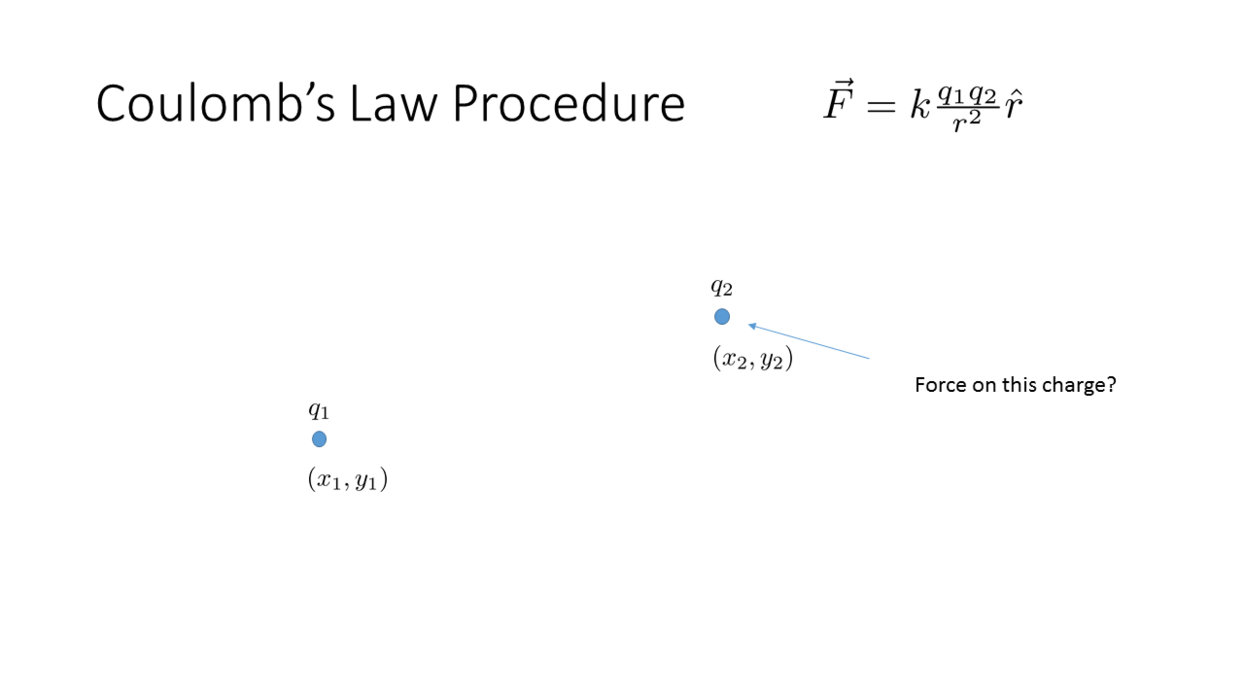
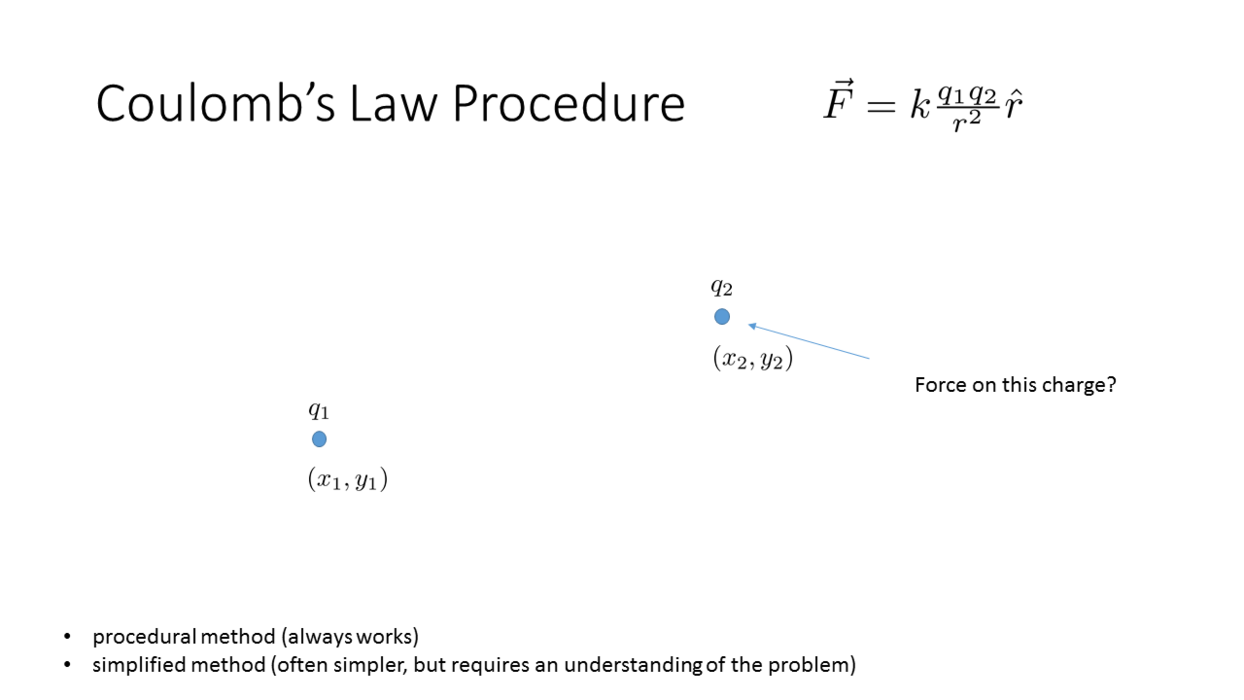
- The simplest way to determine the force exerted on one charge by another in 2 or more dimensions is to use position vectors
- Start out by writing down the position vector for all charges.
- Then follow this notation:
- \(\vec{F}_{12}\) is the force by charge 1 on charge 2.
- \(\hat{r}\) is a unit vector pointing from charge 1 to charge 2.
- \(\Delta \vec{r}_{12}\) is the displacement vector from charge 1 to charge 2
- \(\vec{r}_1 + \Delta \vec{r}_{12} = \vec{r}_2 \rightarrow \Delta \vec{r}_{12} = \vec{r}_2 - \vec{r}_1\)
_ 
_ 
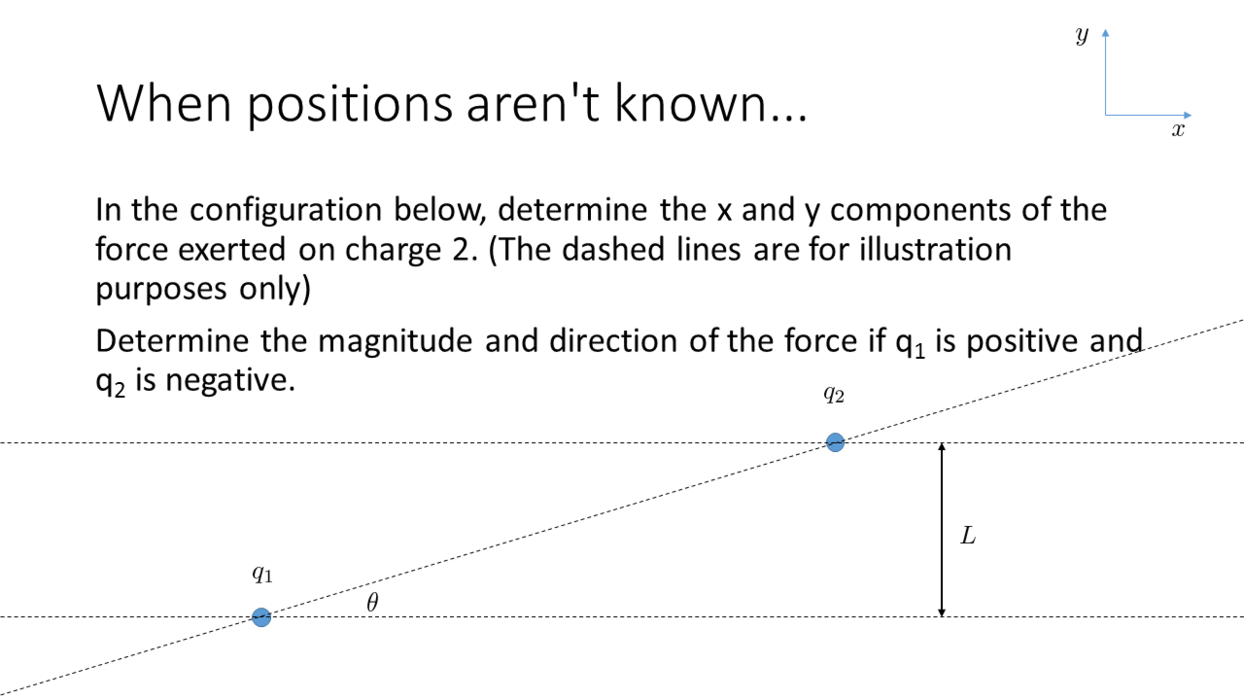
_ 
More than 2 charges
The electric force obeys the principle of superposition. The net force due to two charges is just the (vector) sum of the force due to each charge separately.
Recall: vectors must be added component-wise.
Example
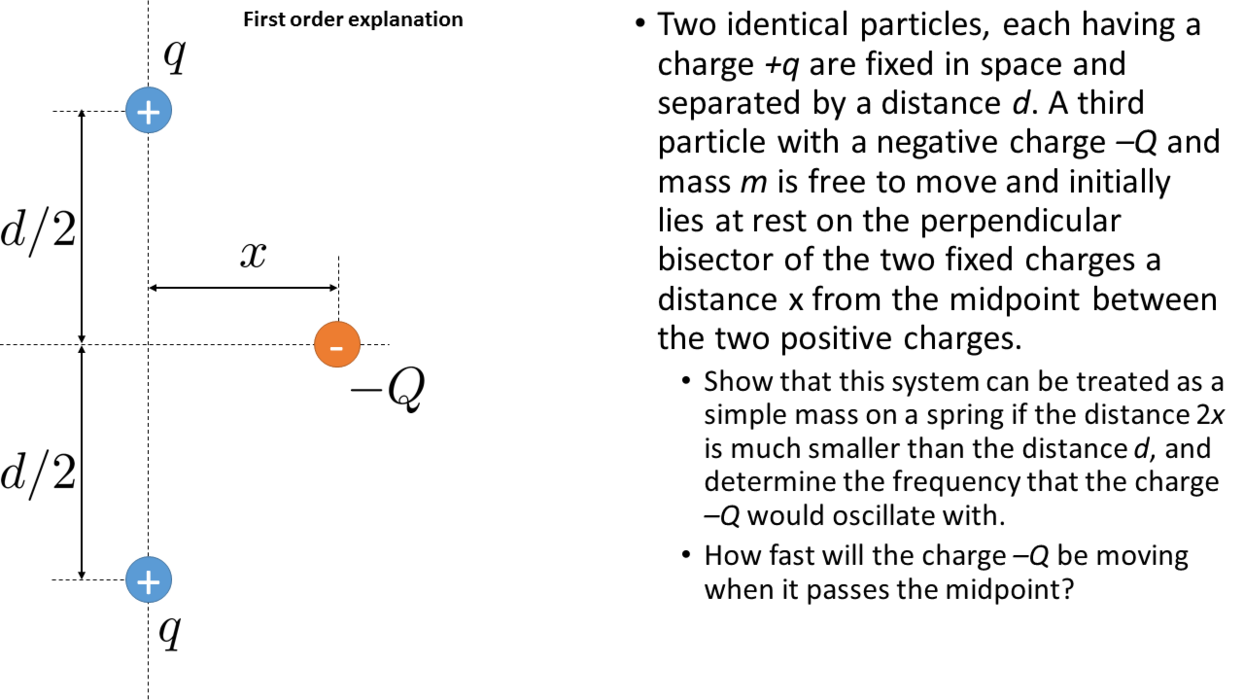
Three charges, \(q_1\),\(q_2\), and \(q_3\) are placed at \((L,0)\), \((0,L)\), and \((0,-L)\) respectively. Determine the force exerted on \(q_2\).
Whiteboards
- Grab a marker
- Find a whiteboard
- Get ready to work some problems
Example
Determine the magnitude of the force (net) exerted on \(q_3\).
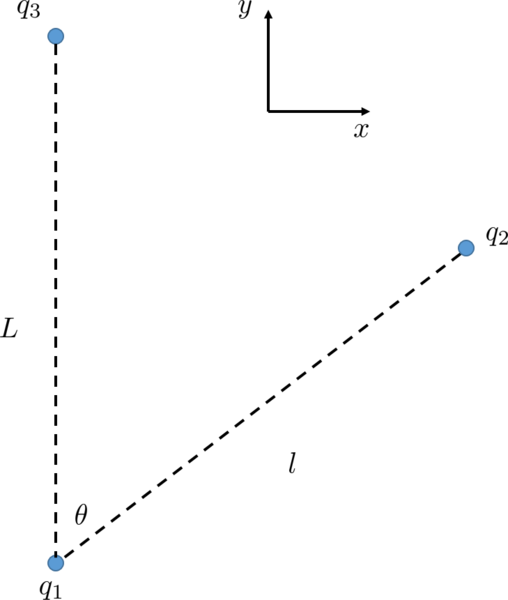
Whiteboards
Consider the three charges below spread uniformly around the arc of a semicircle. Determine the net force exerted on \(q_3\).
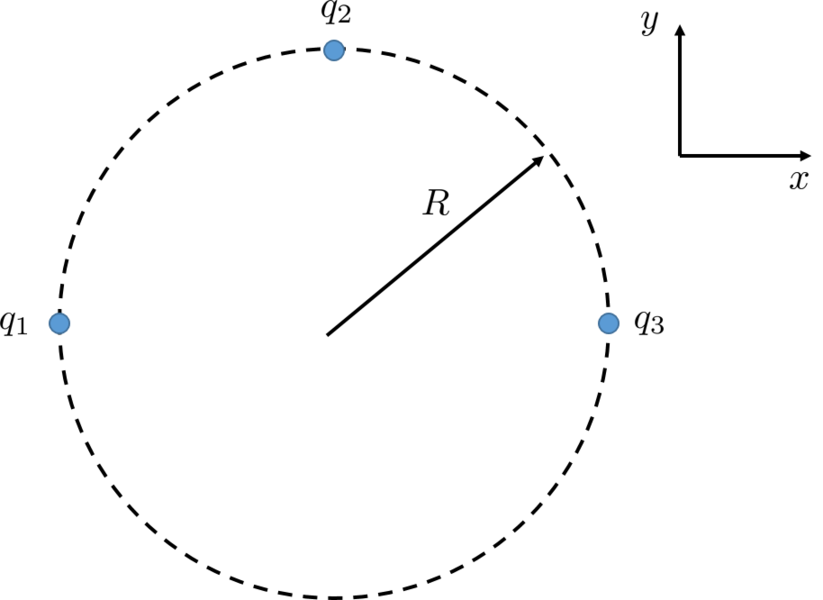
Whiteboards
Consider two point charges, \(q_1\) and \(q_2\) separated by a distance \(L\). Assume that the two charges have the same sign, but not necessarily the same magnitude. How far from \(q_1\) could you place a third charge such that the net force on the third charge was zero?
Whiteboards
A positive point charge \(q_1\) sits at the origin of an \(x-y\) coordinate system. A second positive charge \(q_2\) is placed near \(q_1\) and exerts a force \(\vec{F} = -1 N \hat{x} + 2 N \hat{y}\). Where is \(q_2\)?
Whiteboards
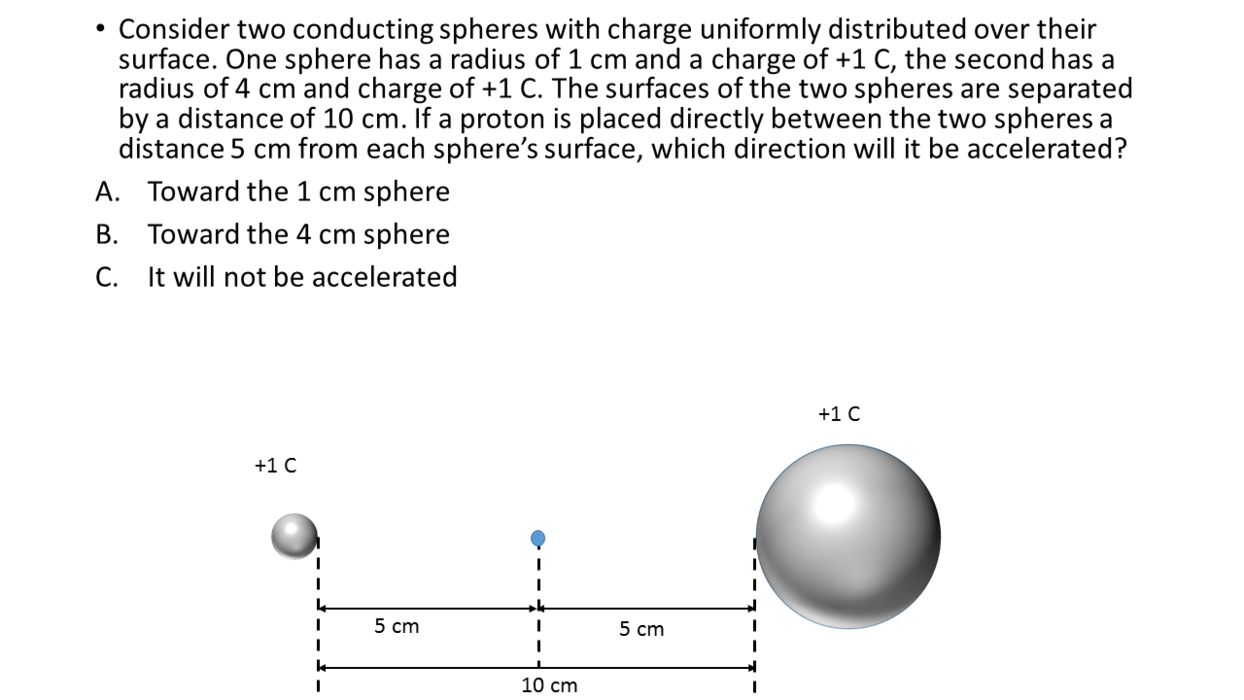
A conducting sphere with excess charge \(Q\) on it is brought into contact with a second conducting sphere that has an excess charge charge \(2Q\) on it. The diameter of the first sphere is twice that of the second, which is \(D\). The spheres are then placed such that their centers are a distance \(L\) apart, and a proton is placed half way between the centers.
What is the acceleration of the proton?
Last Slide
This slide intensionally left blank
Question
- The electrostatic force is very strong compared to gravity, but why don’t we feel it everywhere?
- For example, it is responsible for the normal force, but that only acts over a very short distance.
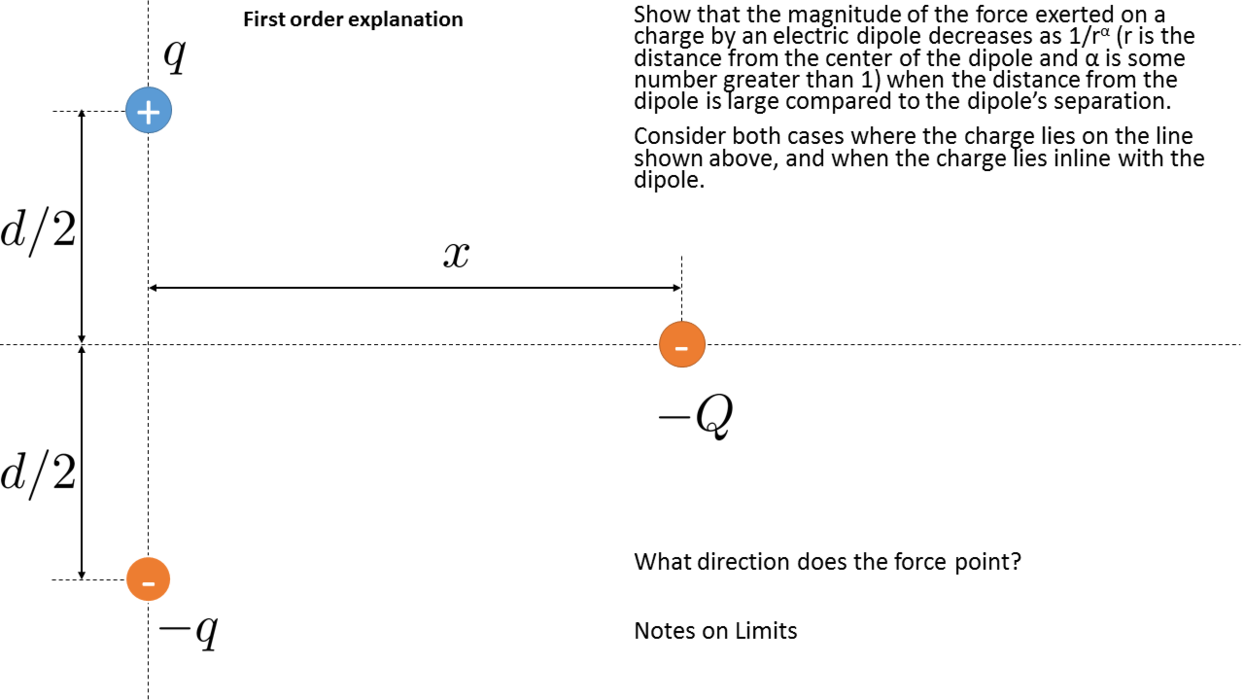
_ 
_ 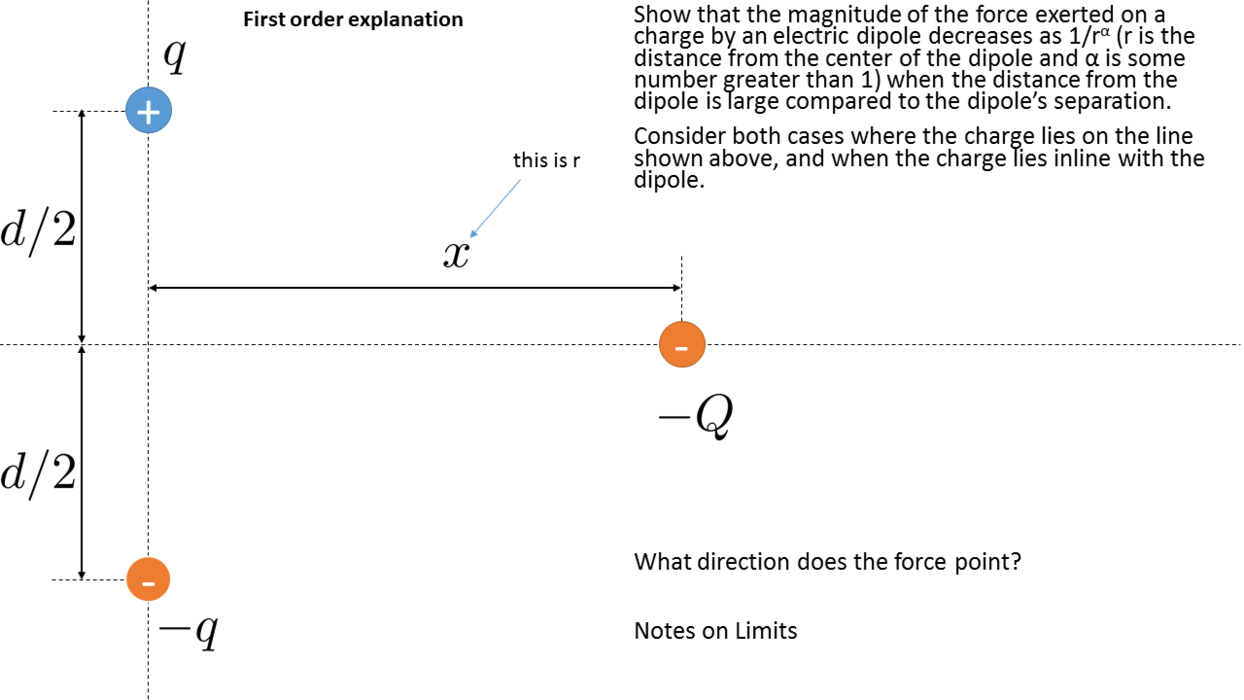
Force from Electric Dipole
Force from Electric Dipole
_