Last Updated: Thu Sep 12 12:49:31 CDT 2024
Maxwell’s Equations
\[ \nabla \cdot \vec{E} =
\frac{\rho}{\epsilon_0} \] \[ \nabla
\cdot \vec{B} = 0 \] \[ \nabla \times
\vec{E} = -\frac{\partial\vec{B}}{\partial t} \] \[ \nabla \times \vec{B} = \mu_0 \vec{J} -\mu_0
\epsilon_0 \frac{\partial\vec{E}}{\partial t} \]
Maxwell’s Equations
| Differential Form |
Integral Form |
| \[ \nabla \cdot \vec{E} =
\frac{\rho}{\epsilon_0} \] |
\[ \oint_S \vec{E} \cdot d\vec{A} =
\frac{q_\text{enc}}{\epsilon_0}\] |
| \[ \nabla \cdot \vec{B} = 0
\] |
\[ \oint \vec{B} \cdot d\vec{A} =
0\] |
| \[ \nabla \times \vec{E} =
-\frac{\partial\vec{B}}{\partial t} \] |
\[ \oint \vec{E} \cdot d \vec{l} = -
\frac{d}{dt} \int_S \vec{B}\cdot d\vec{A}\] |
| \[ \nabla \times \vec{B} = \mu_0 \vec{J}
-\mu_0 \epsilon_0 \frac{\partial\vec{E}}{\partial t} \] |
\[ \oint \vec{B} \cdot d \vec{l} = \mu_0
\int_S \vec{J}\cdot d \vec{l} - \mu_0\epsilon_0\frac{d}{dt} \int_S
\vec{E}\cdot d\vec{A}\] |
Gauss’s Law
\[ \oint_S \vec{E} \cdot d\vec{A} =
\frac{q_\text{enc}}{\epsilon_0}\]
The net electric flux through a closed surface is equal to the charge
enclosed by the surface.
Electric Flux
Gauss’s Law is a law about the electric flux
\[ \Phi = \oint_S \vec{E} \cdot d\vec{A} =
\frac{q_\text{enc}}{\epsilon_0}\]
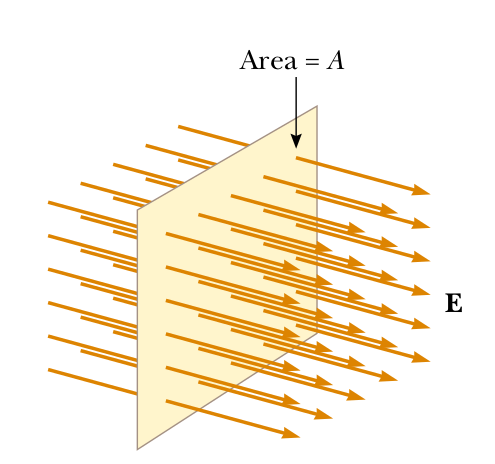
Conceptually, electric flux is proportional to the number of field
lines that pass through a surface.
Electric Flux
For a uniform field, the flux will be constant over a flat surface,
and the integral will just be:
\[ \Phi = \oint_S \vec{E} \cdot d\vec{A}=
\vec{E} \cdot \vec{A}\]
where \(\vec{A}\) is an area
vector.
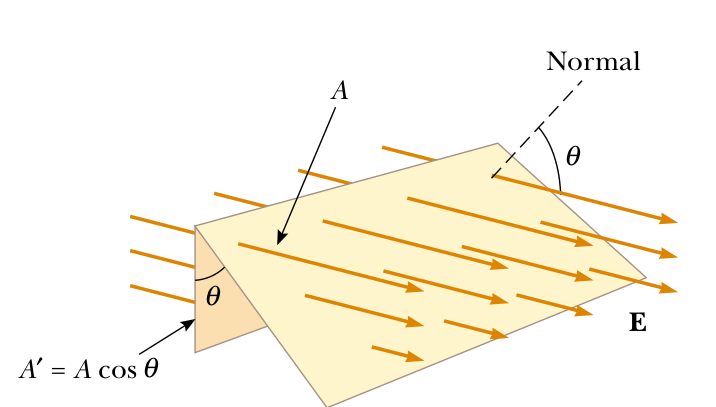
Electric Flux
For a uniform field, the flux will be constant over a flat surface,
and the integral will just be:
\[ \Phi = \oint_S \vec{E} \cdot d\vec{A}
= \vec{E} \cdot \vec{A}\]
where \(\vec{A}\) is an area
vector.
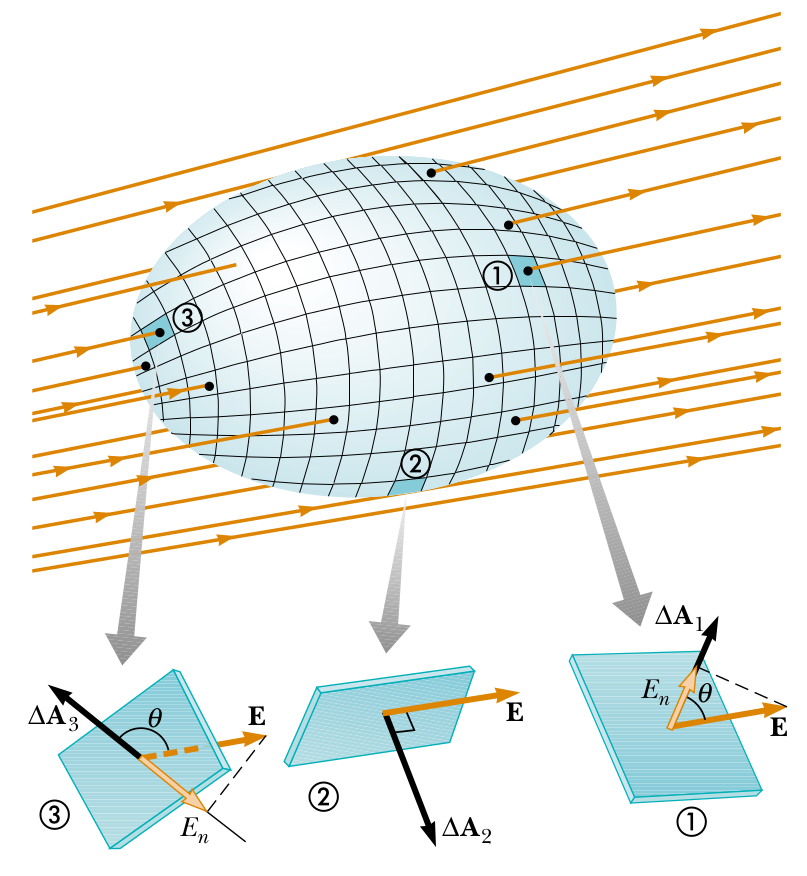
Electric Flux
For a non-uniform field, or an arbitrary surface, the integral
calculates the flux by breaking the surface into small area elements,
computing the flux for each element, and adding them all together.
\[ \Phi = \oint_S \vec{E} \cdot d\vec{A}
\]
Field from a point charge
Gauss’s Law gives us Coulomb’s Law!
\[ \oint_S \vec{E} \cdot d\vec{A} =
\frac{q_\text{enc}}{\epsilon_0}\]
Consequences of Gauss’s Law: Charge on Conductors
The electric field inside a conductor must be zero when the conductor
is in electrostatic equilibrium.
And Gauss’s Law holds for any imaginary surface…
\[ \Phi = \oint_S \vec{E} \cdot d\vec{A} =
\frac{q_\text{enc}}{\epsilon_0}\]
- Excess charge sits on the surface of the conductor.
- If charge exists inside a cavity, the surface of the
conductor surrounding the cavity will accumulate equal an opposite
charge to that in the cavity.
Example
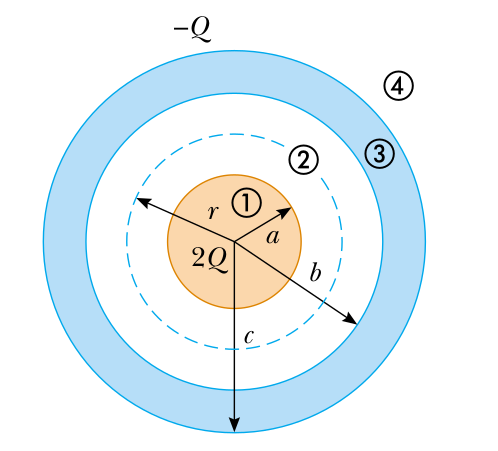
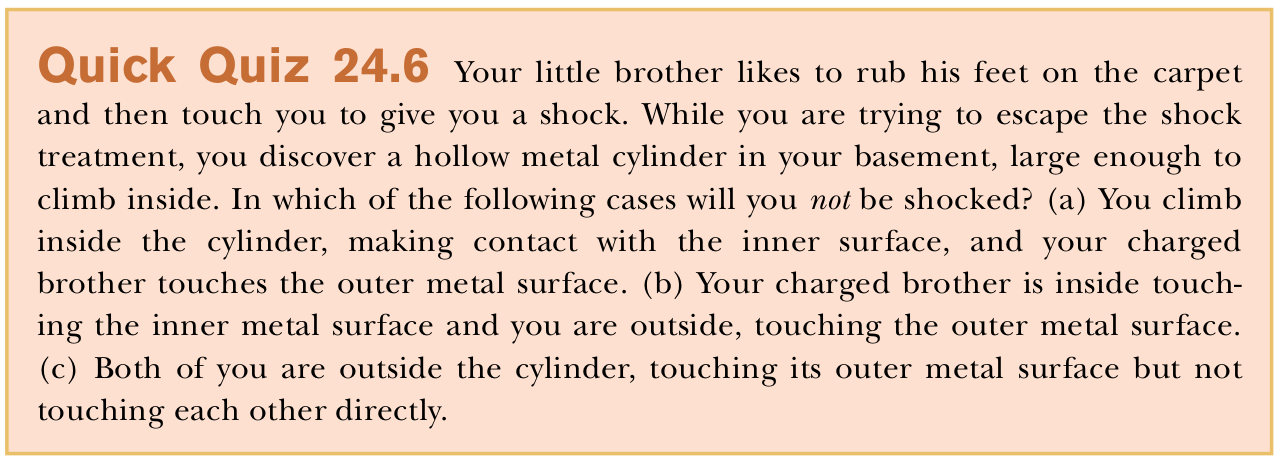
A solid conducting sphere of radius \(a\) carries a net positive charge \(2Q\). A conducting spherical shell of inner
radius \(b\) and outer radius \(c\) is concentric with the solid sphere and
carries a net charge \(-Q\). Find the
electric field in teh regions labeled 1 - 4, and the charge distribution
on the shell when the entire system is in electrostatic equilibrium.
(Fun) Example
Field From Charge Distributions
Electric Field produced by:
- a long line
of charge.
- a large sheet of charge.
- a long cylinder shell of charge.
- a long solid cylinder of charge.
- a spherical shell of charge.
- a solid sphere of charge.
- a long solid conducting cylinder.
- a large solid conducting sheet.
- a large solid conducting sphere.
How much charge does the Van de Graaff generator build up?
The dielectric strength of air is \(3\times
10^6\) N/C. This means that for a strong enough electric field
(\(> 3\times 10^6\) N/C), air will
become a conductor.
How much charge has to build up on the generator for the electric
field to exceed the dialectric strength of air?
Whiteboards
A sphere of radius \(R\), centered
on the origin, has a total charge \(Q\)
distributed uniformly through its volume.
Determine the electric field produced by this charge distribution
along the \(x\) axis (i.e. what is
\(\vec{E}(x,0,0)\)).
Sketch a graph of the x-component of the electric field along the
\(x\) axis from \(+\infty\) to \(-\infty\).
Whiteboards
Last Slide